Table of Contents
- Why Understanding Wallet Types Matters for Your Brand
- The Complete Taxonomy of Modern Wallets
- Bi-Fold Wallets: Classic Design and Market Appeal
- Tri-Fold Wallets: Maximum Organization in Compact Form
- Card Holders and Card Cases: The Minimalist Revolution
- Long Wallets and Checkbook Styles
- Zip-Around Wallets: Security Meets Style
- Wristlet Wallets: Hands-Free Convenience
- Coin Purses and Money Clips: Traditional Accessories
- Travel Wallets and Passport Holders
- RFID-Blocking Wallets: Technology-Driven Category
- Women's vs Men's Wallet Markets: Key Differences
- Material Choices by Wallet Type
- Price Point Positioning Across Categories
- Which Wallet Types Offer the Best Margins for New Brands
- FAQ — Wallet Types and Buying Decisions
The global wallet market generates over $12 billion in annual retail revenue, making it one of the most profitable accessory categories for brands, boutiques, and private label programs. Yet despite its size, many emerging brands underestimate the complexity of wallet category selection. Choosing which wallet types to include in your product line is a strategic decision that affects your manufacturing costs, target market positioning, inventory complexity, and long-term brand identity.
This comprehensive guide examines every major wallet type available in today's market, from the classic bi-fold to the technology-enhanced RFID-blocking designs. For each category, we analyze market demand, manufacturing considerations, price positioning, and margin potential. Whether you are launching a leather goods brand, expanding an existing accessories line, or curating a boutique collection, this guide provides the data and frameworks you need to make informed product decisions. For brands ready to explore custom wallet manufacturing, our private label services offer full customization from design to delivery.
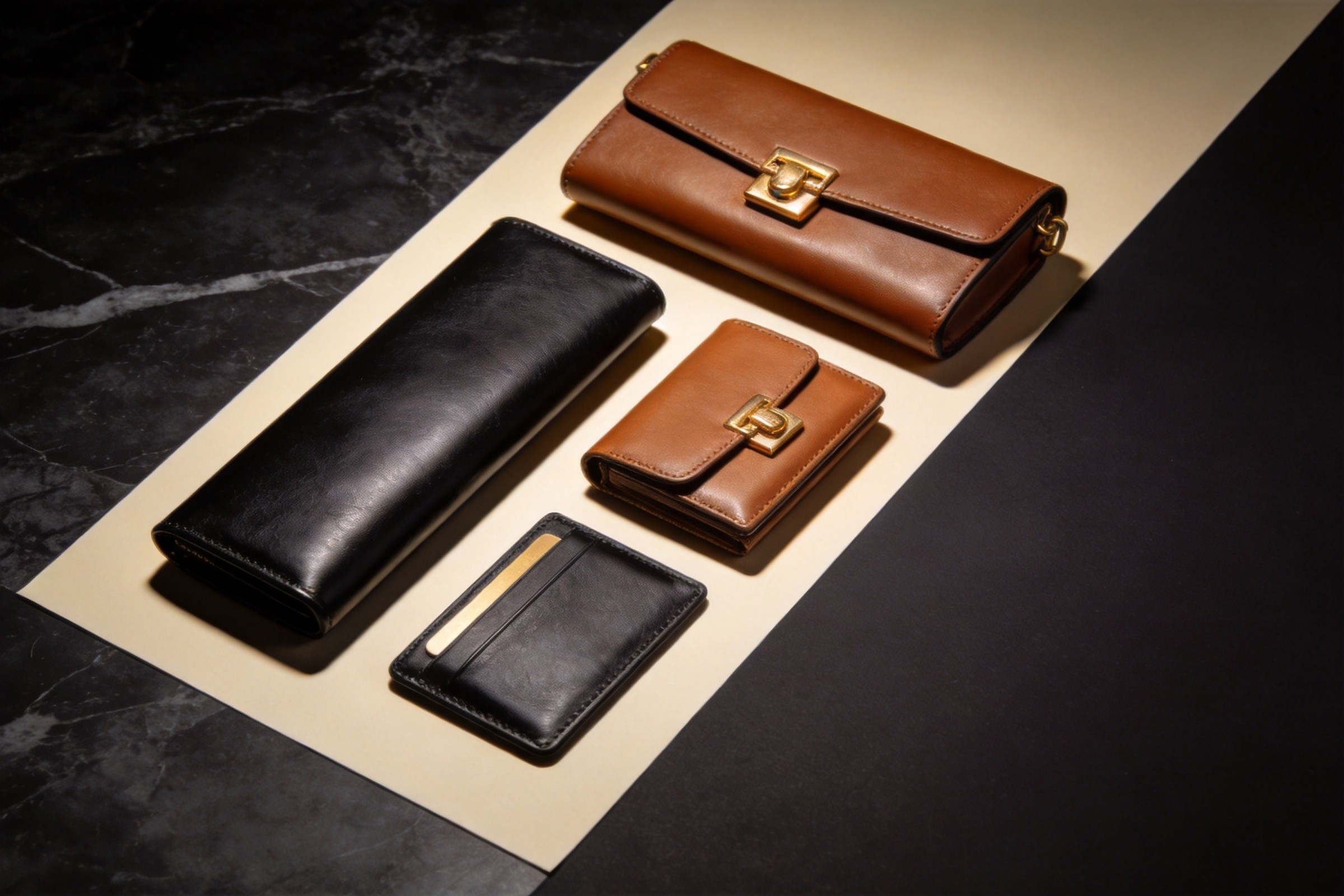
Understanding the full spectrum of wallet types helps brands build strategically balanced product lines
Why Understanding Wallet Types Matters for Your Brand
Wallet category selection is not merely a product design decision. It is a business strategy choice that ripples through every aspect of your operation. The wallet types you choose determine your pattern-making complexity, material sourcing requirements, production timelines, inventory SKU count, and ultimately your profitability. A brand that launches with five well-chosen wallet types will outperform a competitor who offers fifteen confused options.
Market data reveals that the top-performing wallet brands maintain focused collections of six to eight core styles, each serving a distinct consumer need and price point. These brands achieve higher per-SKU profitability because they concentrate their manufacturing volume, reduce material waste, and build recognition around specific silhouettes that become synonymous with their brand identity. The global wallet market is projected to grow at a compound annual growth rate of 5.8 percent through 2028, driven by rising disposable incomes in Asia-Pacific markets and the growing preference for premium leather accessories. Brands entering this market with a clear understanding of wallet categories have a significant advantage over those who treat wallets as an afterthought to their handbag lines.
Consider also that wallets serve as excellent entry-point products for new brands. They carry lower price points than handbags, which reduces the customer's purchase risk, while still offering ample opportunity for quality differentiation through materials, craftsmanship, and branding. Many successful leather goods brands, including several that now generate over $100 million in annual revenue, started with a focused wallet collection before expanding into bags and larger accessories. Explore our solutions for emerging brands to learn how to build a wallet-first strategy.
The Complete Taxonomy of Modern Wallets
The wallet market encompasses a diverse range of styles, each designed for specific use cases, demographics, and price positions. Understanding this taxonomy is essential for brands planning their product architecture. Below is a comprehensive overview of the major wallet categories available in today's market.
| Wallet Type | Market Share | Avg Retail Price | Primary Demographic | Growth Trend |
|---|---|---|---|---|
| Bi-Fold Wallet | 35-40% | $35 - $120 | Men and Women (Universal) | Stable |
| Card Holder | 18-22% | $25 - $80 | Millennials, Professionals | Fast Growing |
| Tri-Fold Wallet | 12-15% | $30 - $95 | Women, Organization-focused | Declining |
| Zip-Around Wallet | 10-12% | $40 - $150 | Women, Security-conscious | Growing |
| Long Wallet | 5-7% | $35 - $110 | Women, Fashion-forward | Stable |
| Wristlet Wallet | 4-6% | $30 - $90 | Women, Active lifestyle | Growing |
| Travel Wallet | 4-5% | $45 - $180 | Frequent travelers | Fast Growing |
| Coin Purse / Money Clip | 3-5% | $20 - $75 | Men, Minimalists | Niche |
This distribution varies significantly by region and demographic. In Asian markets, for example, long wallets and zip-around styles command higher market share due to cultural preferences for larger silhouettes and coin storage. In North American and European markets, the trend toward minimalism has accelerated card holder growth at the expense of traditional multi-fold designs. Understanding your target market's preferences within this taxonomy is critical for product planning.
Bi-Fold Wallets: Classic Design and Market Appeal
The bi-fold wallet is the undisputed king of wallet styles, representing approximately 35 to 40 percent of global wallet sales. Its enduring popularity rests on a simple principle: the perfect balance between storage capacity and pocket-friendly dimensions. A well-designed bi-fold wallet holds eight to twelve cards, features a bill compartment, and folds compactly enough to sit comfortably in a front or back pocket without creating bulk.
For brands, bi-fold wallets offer exceptional manufacturing efficiency. The pattern requires fewer pieces than tri-fold or zip-around designs, reducing both material waste and assembly time. The standard bi-fold construction involves an outer shell, an inner lining panel, card slot layers, and a bill divider, typically assembled through a combination of machine stitching and hand finishing. Production complexity is moderate, making bi-fold wallets ideal for brands new to leather goods manufacturing.
The bi-fold wallet remains the best-selling style globally due to its perfect balance of function and form
Bi-fold wallets serve both men's and women's markets effectively, though the design language differs significantly between demographics. Men's bi-folds tend toward slimmer profiles with emphasis on card capacity and minimal external branding. Women's bi-folds often incorporate additional features like coin pockets, ID windows, and checkbook compartments, resulting in slightly larger dimensions. The unisex trend has also created opportunity for gender-neutral bi-fold designs that appeal to younger consumers who prefer understated aesthetics.
Bi-Fold Wallet Key Specifications
Standard dimensions: 4.5 x 3.5 inches (closed). Card capacity: 8-12 slots. Bill compartment: Full-width, divided. Material: Full-grain or top-grain leather. Production time: 45-60 minutes per unit. Typical MOQ: 200 pieces per color.
Tri-Fold Wallets: Maximum Organization in Compact Form
Tri-fold wallets add a third panel to the bi-fold design, creating a more compact footprint when folded while offering additional storage capacity. This design is particularly popular in the women's wallet market, where the extra panel accommodates additional card slots, a zippered coin compartment, and sometimes a checkbook section. The tri-fold's compact folded size makes it ideal for small handbags and clutch purses.
From a manufacturing perspective, tri-fold wallets present moderately higher complexity than bi-folds. The additional fold panel requires precise pattern alignment, and the increased number of card slots means more stitching operations. Production time typically runs 60 to 80 minutes per unit, compared to 45 to 60 minutes for bi-folds. This additional labor translates to approximately 15 to 25 percent higher manufacturing costs, which must be factored into your pricing strategy.
Market data suggests tri-fold wallets are experiencing a gradual decline in market share, losing ground to card holders and minimalist designs among younger consumers. However, they maintain strong loyalty among customers who prioritize organization and maximum storage. Brands targeting demographics aged 35 and above, particularly in markets where cash and coin usage remain common, will find steady demand for well-designed tri-fold wallets. Learn more about manufacturing differences between bi-fold and tri-fold styles in our dedicated comparison.
Tri-fold wallets offer maximum organization in a compact form factor, ideal for organization-focused consumers
Card Holders and Card Cases: The Minimalist Revolution
The card holder represents the fastest-growing segment in the wallet market, driven by the global shift toward cashless transactions and the minimalist carry movement. In markets like Sweden, China, and South Korea, where contactless payments account for over 70 percent of consumer transactions, traditional wallets with dedicated bill compartments are becoming unnecessary for many consumers. The card holder, stripped down to essentials, has emerged as the dominant form factor.
A typical card holder features four to eight card slots in a slim, pocket-friendly profile measuring approximately 4 x 3 inches. Some designs incorporate a central cash slot or money clip, but the emphasis remains on minimalism. Manufacturing is simpler than multi-fold wallets, with fewer pattern pieces, reduced stitching, and lower material consumption. This efficiency makes card holders the highest-margin wallet category for brands, with typical gross margins of 65 to 75 percent at retail.
For brands entering the wallet market, card holders offer the lowest barrier to entry. Production costs are lower, MOQs are achievable for startups, and the design canvas, while small, allows significant differentiation through material choice, edge finishing, embossing, and hardware details. The card holder category also lends itself to personalization and limited-edition releases, creating opportunities for brand building and customer engagement.
Long Wallets and Checkbook Styles
Long wallets, also known as checkbook wallets or Continental wallets, feature an elongated silhouette that typically measures 7.5 to 8 inches in width. These wallets never fold smaller than approximately 4 inches, making them unsuitable for pocket carry. They are designed exclusively for handbag carry and serve as a fashion accessory as much as a functional item.
Long wallets offer the maximum interior capacity of any wallet style, often featuring fifteen or more card slots, multiple bill compartments, a zippered coin section, a checkbook holder, a pen loop, and sometimes even a small mirror or phone holder. This capacity makes them popular among professionals who carry business cards, identification documents, and multiple payment methods.
| Feature | Long Wallet | Bi-Fold Wallet | Card Holder |
|---|---|---|---|
| Dimensions (closed) | 7.5 x 4 inches | 4.5 x 3.5 inches | 4 x 3 inches |
| Card Slots | 12-20 | 8-12 | 4-8 |
| Bill Compartments | 2-3 | 1-2 | 0-1 |
| Coin Pocket | Yes (zippered) | Optional | No |
| Production Time | 75-100 min | 45-60 min | 25-40 min |
| Avg Manufacturing Cost | $12 - $22 | $8 - $15 | $4 - $8 |
| Typical Retail Price | $65 - $150 | $35 - $120 | $25 - $80 |
The long wallet market shows steady demand, particularly in Asian and European markets where handbag carry is the norm. For brands, long wallets offer higher absolute dollar margins per unit and excellent opportunities for premium material and hardware showcase. However, they require more material per unit and have higher production costs. Our product catalog features several long wallet designs that demonstrate effective construction approaches for this category.
Zip-Around Wallets: Security Meets Style
Zip-around wallets have gained significant market share over the past decade, driven by consumer demand for security and the perception that zipped closures offer superior protection for cards and cash. The zip-around design features a zipper that wraps around three sides of the wallet, allowing it to open flat like a book while keeping contents securely enclosed when closed.
This style is overwhelmingly popular in the women's market, where it serves double duty as both wallet and small clutch. Many zip-around designs are sized to hold a smartphone, making them functional as evening bags or minimalist day bags. The dual functionality justifies premium pricing, with zip-around wallets commanding 20 to 35 percent higher retail prices than comparable bi-fold designs.
Manufacturing zip-around wallets requires specialized zipper sewing equipment and skilled operators. The zipper must be precisely aligned to ensure smooth operation around all corners, and quality control must verify that the zipper does not catch on the interior lining or card slots. These additional manufacturing requirements translate to higher production costs but also create a natural barrier to entry for low-quality competitors. Brands that master zip-around construction signal quality and attention to detail to their customers.

Zip-around wallets combine security with style, commanding premium pricing in the women's market
Wristlet Wallets: Hands-Free Convenience
Wristlet wallets represent the intersection of wallet functionality and wearable convenience. Featuring an attached wrist strap or short handle, these designs allow the user to carry essentials without occupying hand space or requiring a larger bag. Wristlets have grown in popularity alongside the athleisure and minimal-carry trends, particularly among active consumers who want secure, accessible storage during errands, travel, and social occasions.
From a manufacturing standpoint, wristlet wallets add a strap component and attachment hardware to a standard wallet base. The strap may be leather, chain, or woven fabric, and attachment methods include permanent stitching, D-ring clips, or snap buttons. The additional components increase material cost by approximately $1.50 to $3.00 per unit and add 10 to 15 minutes of assembly time. The retail price premium, however, typically ranges from 25 to 40 percent above equivalent non-wristlet designs, making wristlets a highly profitable variation.
Wristlets also serve as an effective product line extension strategy. Brands can offer the same wallet design in both standard and wristlet versions, creating additional SKUs from existing patterns and tooling. This approach maximizes design investment while offering customers choice. For brands exploring custom manufacturing, our team at Junyuan Bags can develop wristlet variations from any wallet base design within the standard sampling timeline.
Coin Purses and Money Clips: Traditional Accessories
While coin purses and money clips represent a smaller share of the overall wallet market, they serve important niches and offer unique branding opportunities. Coin purses remain essential accessories in markets where coin currency is prevalent, including Japan, the Eurozone, and many Southeast Asian countries. Money clips, conversely, appeal to the minimalist male demographic that prioritizes slim carry over traditional wallet formats.
Coin purses range from small, simple pouch-style designs to elaborate frame Kiss-lock purses with metal clasps. The frame Kiss-lock design, in particular, offers significant branding opportunity through custom metal frames that can be cast with brand logos, decorative patterns, or gemstone accents. Manufacturing metal frame coin purses requires coordination between leather working and metal casting operations, which increases lead time but also creates distinctive products that are difficult for competitors to replicate.
Money clips offer the simplest construction of any wallet category, often consisting of a single piece of leather or metal with a folding mechanism. Premium leather money clips with embedded magnets provide secure bill holding in an ultra-slim profile. These products are excellent entry-level items for men's leather goods brands, with low production costs and attractive retail margins of 60 to 70 percent.
Coin purses and money clips serve important niche markets with unique branding opportunities
Travel Wallets and Passport Holders
The travel wallet category has experienced remarkable growth as international travel has recovered and expanded post-pandemic. Travel wallets combine traditional wallet functions with dedicated compartments for passports, boarding passes, travel documents, foreign currency, and multiple currencies of credit cards. They represent the highest price point in the wallet category, with premium travel wallets retailing from $80 to over $200.
A well-designed travel wallet typically includes a passport-sized compartment, at least six card slots, two or three bill compartments sized for different currencies, a boarding pass pocket, a pen holder, and often a RFID-blocking layer. The larger size accommodates these features while still fitting inside a carry-on bag or personal item. Some premium designs incorporate a removable card holder that functions independently as a daily wallet, adding versatility that justifies the investment.
For brands, travel wallets offer several strategic advantages. The higher price point means higher absolute margin per unit. The functional complexity creates perceived value that supports premium pricing. And the travel association creates natural marketing opportunities through travel influencer partnerships, airport retail placements, and seasonal campaigns aligned with vacation planning periods. The global travel accessories market is valued at over $25 billion, with travel wallets representing one of the fastest-growing sub-segments.
RFID-Blocking Wallets: Technology-Driven Category
RFID-blocking wallets incorporate a specialized shielding layer that prevents unauthorized scanning of contactless credit cards and identification documents. While the actual threat of RFID skimming remains relatively low in most environments, consumer perception of the risk drives significant demand. Over 68 percent of wallet buyers now consider RFID protection an important feature, and wallets with RFID-blocking capability command a 15 to 25 percent price premium over non-RFID equivalents.
The RFID-blocking function is achieved through a thin layer of metallic mesh or carbon fiber material integrated into the wallet's construction, typically positioned between the outer leather shell and the inner lining. This layer creates a Faraday cage effect that blocks the electromagnetic fields used by RFID scanners. The technology adds minimal thickness (approximately 0.3mm) and negligible weight to the finished wallet.
RFID-blocking capability can be incorporated into virtually any wallet type, from card holders to travel wallets. For brands, it serves as both a functional differentiator and a marketing tool. The technology story provides compelling content for product descriptions, social media, and packaging. For a deeper analysis of the RFID wallet opportunity, see our guide on RFID wallet market opportunity and manufacturing.
RFID-blocking technology adds a compelling functional story that justifies premium pricing across all wallet categories
Women's vs Men's Wallet Markets: Key Differences
The wallet market splits roughly 55 percent women's and 45 percent men's, with distinct preferences, purchasing behaviors, and design expectations in each segment. Understanding these differences is critical for brands planning their product architecture.
| Attribute | Women's Wallets | Men's Wallets |
|---|---|---|
| Top Selling Style | Zip-Around / Long Wallet | Bi-Fold |
| Primary Purchase Driver | Style + Organization | Function + Durability |
| Avg Retail Price | $45 - $150 | $35 - $120 |
| Color Preferences | Diverse (black, tan, blush, seasonal) | Conservative (black, brown, navy) |
| Card Capacity Need | 10-20 slots | 6-12 slots |
| Coin Pocket | Essential in most markets | Optional / Rare |
| Purchase Frequency | 1-2 times per year | Every 2-3 years |
| Brand Sensitivity | Higher | Moderate |
These differences have direct implications for product design, pricing, and marketing. Women's wallet brands invest more in seasonal color stories, hardware aesthetics, and interior organization features. Men's wallet brands emphasize material quality, slim profiles, and durability claims. Brands that attempt to serve both markets with identical designs typically underperform in both segments, as neither customer feels the product was designed specifically for their needs.
Material Choices by Wallet Type
Material selection is one of the most important decisions in wallet design, directly affecting perceived quality, durability, manufacturing cost, and retail pricing. Different wallet types lend themselves to different material approaches, and understanding these relationships helps brands make optimal choices.
Full-grain leather remains the gold standard for premium wallets across all categories. Its natural surface, which retains the original grain pattern of the hide, communicates authenticity and luxury. Full-grain leather develops a rich patina over time, actually improving in appearance with use. This characteristic is particularly valued in men's bi-fold wallets and card holders, where the aging process becomes part of the product's personal story.
Top-grain leather, which has been sanded and refinished to remove natural imperfections, offers a more uniform appearance at a lower cost. It is the most popular choice for mid-range wallet lines and works well across all wallet types. Bonded leather and high-quality PU leather serve the budget segment, providing the appearance of leather at a fraction of the cost. These synthetic materials have improved dramatically in recent years, with some premium PU options that are difficult to distinguish from genuine leather by touch alone.
For brands exploring non-leather options, materials like cork, recycled ocean plastics, pineapple leaf fiber (Pinatex), and mushroom leather (Mycelium) are gaining traction in the sustainability-focused segment. These materials command premium pricing due to their novelty and environmental story, though they present manufacturing challenges related to durability and consistency.
Price Point Positioning Across Categories
Strategic price positioning across wallet categories is essential for brands building a comprehensive product line. The goal is to offer accessible entry points while maintaining premium options that elevate brand perception and maximize profitability.
At the entry level ($20-$40 retail), card holders and simple bi-fold wallets in PU leather or split leather serve as impulse purchases and gift items. These products attract new customers to your brand with minimal investment risk. The mid-range ($40-$80 retail) encompasses the core of most wallet lines, featuring top-grain leather bi-folds, tri-folds, and wristlets with quality hardware and finishing. The premium tier ($80-$150 retail) includes full-grain leather designs, zip-around wallets, and travel wallets with RFID protection and premium packaging. The luxury tier ($150+) encompasses exotic skins, hand-stitched designs, and limited-edition collaborations.
Price Positioning Framework
Entry ($20-40): Card holders, simple bi-folds, PU leather. Mid-range ($40-80): Top-grain bi-folds, tri-folds, wristlets. Premium ($80-150): Full-grain leather, zip-arounds, travel wallets. Luxury ($150+): Exotic skins, hand-stitched, limited editions. Target 55-75% gross margin across all tiers.
Which Wallet Types Offer the Best Margins for New Brands
For new brands entering the wallet market, margin efficiency is paramount. Every dollar of initial capital must work as hard as possible, which means prioritizing wallet types that deliver the highest return on manufacturing investment.
Card holders lead the margin rankings, offering 65 to 75 percent gross margins at retail with the lowest absolute manufacturing cost ($4-$8 per unit). Their simple construction means fewer quality control variables, lower reject rates, and faster production turnaround. Bi-fold wallets follow with 55 to 65 percent margins and slightly higher absolute dollar profits due to their higher retail prices. Zip-around wallets deliver 60 to 70 percent margins with the highest absolute profit per unit, but require greater manufacturing expertise and investment in specialized equipment.
The optimal launch strategy for new wallet brands typically involves a three-product collection: a card holder as the entry-level impulse purchase, a bi-fold wallet as the core product, and one premium piece (either a zip-around or travel wallet) to establish brand credibility at the higher end. This approach covers multiple price points with minimal SKU complexity, allows shared material sourcing across styles, and creates natural upsell pathways for customers who enter through the card holder and graduate to more expensive pieces over time. Contact Junyuan Bags to discuss your wallet collection strategy with our experienced team.
A strategic three-product wallet collection covers key price points while minimizing initial investment
Ready to Launch Your Wallet Collection?
Junyuan Bags brings 20+ years of leather goods expertise to your wallet brand. From card holders to travel wallets, we manufacture every style with precision craftsmanship.
WhatsApp: +86 17750020688 | Email: service@junyuanbags.com
Factory: 30,000 sqm, 300+ workers, Quanzhou, China
MOQ: 200 pcs/style — Perfect for new brands
Frequently Asked Questions
What is the most popular wallet type globally?
The bi-fold wallet is the most popular wallet type globally, representing 35 to 40 percent of all wallet sales. Its universal appeal across demographics, balanced storage capacity, and pocket-friendly design make it the safest starting point for new brands. The card holder is the fastest-growing category, driven by the cashless payment trend and minimalist consumer preferences.
What is the best material for manufacturing wallets?
Full-grain leather is the premium choice offering the highest perceived value and durability. Top-grain leather provides the best balance of quality and cost for mid-range brands. High-quality PU leather serves budget-friendly lines with increasingly convincing leather-like appearance. The best choice depends on your target retail price point and brand positioning.
Is RFID-blocking technology necessary in modern wallets?
While actual RFID skimming risk is low, consumer demand for RFID protection is high, with 68 percent of buyers considering it important. The technology adds only $1.50-$3.00 in cost but allows a 15-25 percent price premium. For brands, including RFID protection is a cost-effective way to add perceived value and differentiate from competitors.
What is the typical MOQ for custom wallet production?
Most established manufacturers require 200-300 pieces per style per color. Junyuan Bags offers 200-piece MOQs with full customization including leather selection, hardware branding, and interior layout. Some manufacturers offer 100-piece trial orders at slightly higher unit costs. Per-unit costs decrease significantly at 500+ piece quantities.
Which wallet types offer the best profit margins for new brands?
Card holders deliver the highest margins at 65-75 percent with the lowest manufacturing costs. Bi-fold wallets offer 55-65 percent margins with higher absolute profits. For new brands, a collection combining a card holder (entry), bi-fold (core), and one premium style provides optimal margin coverage with minimal complexity and investment.
How long does it take to develop a custom wallet from design to production?
The typical timeline is 30-45 days for sampling (including design review, pattern making, and sample production) plus 45-60 days for bulk production after sample approval. First-time collaborations may add 1-2 weeks for material sourcing and communication alignment. Complex designs with exotic materials or custom hardware may extend the timeline by an additional 2-3 weeks.
Limitations and Scope of This Guide
This guide covers complete buying guide to wallet types for brands, including bi-folds, tri-folds, card holders, coin purses, and travel wallets. It is based on our experience as a handbag manufacturer in Quanzhou, China, serving brands worldwide since 2004. Key limitations to keep in mind:
- This guide covers the most common wallet categories. Hybrid designs and emerging formats (digital wallet cases, modular wallets) may not fit neatly into these categories.
- Market preference data reflects Western consumer habits. Wallet usage patterns differ significantly in markets with high mobile payment adoption (China, Scandinavia).
- Material and construction recommendations are based on mid-to-premium positioning. Budget wallet lines require different material selections and cost engineering.
For advice tailored to your specific situation, contact our team directly.