Table of Contents
- Why Shopify Is the Top Platform for DTC Handbag Brands
- Setting Up Your Shopify Store for Handbags
- Theme Selection and Brand Design
- Product Page Optimization for Handbags
- Sourcing Handbags for Your Shopify Store
- Inventory Management Strategies
- Third-Party Logistics for Handbag Fulfillment
- Shipping Strategy and Free Shipping Thresholds
- Returns and Exchanges Policy for Handbags
- Payment Processing and Currency Options
- Email Marketing Integration
- Social Media Integration — Instagram and TikTok
- Analytics and KPIs to Track
- Essential Apps and Tools for Handbag Stores
- Scaling from Shopify to Multi-Channel
- FAQ — Building a Handbag Brand on Shopify
Shopify powers over 4.8 million e-commerce stores worldwide, and handbag brands represent one of the platform's strongest fashion categories. The combination of beautiful themes, powerful integrations, and complete brand control makes Shopify the preferred platform for entrepreneurs building direct-to-consumer handbag businesses. This guide covers every operational aspect of running a handbag brand on Shopify, from store setup to fulfillment optimization.
Whether you are launching your first store or optimizing an existing one, this guide provides specific, actionable recommendations for handbag sellers. From product page layouts that drive conversions to fulfillment strategies that delight customers, every section addresses the unique requirements of selling handbags through Shopify. For the product sourcing side, explore our handbag collection for customizable designs ready for your brand.

A well-designed Shopify store communicates brand quality from the first scroll
Why Shopify Is the Top Platform for DTC Handbag Brands
Shopify offers handbag brands a complete e-commerce ecosystem that balances ease of use with powerful functionality. Unlike marketplace platforms where you compete directly with similar products on the same page, Shopify gives you a dedicated storefront where every element reinforces your brand identity. You control the customer experience from first impression through post-purchase follow-up.
The platform's app ecosystem provides solutions for every operational need: inventory management, email marketing, social media integration, reviews, loyalty programs, and international selling. Shopify's reliability, security (PCI-DSS compliant), and mobile-responsive themes ensure your store performs flawlessly across devices. With 70 percent of fashion e-commerce traffic coming from mobile, this performance is non-negotiable.
Setting Up Your Shopify Store for Handbags
Shopify store setup for handbags follows the same foundational process as any e-commerce store, with specific considerations for fashion accessories. Configure your store settings including store name, currency, shipping zones, tax settings, and payment providers. Choose a Shopify plan that matches your current stage: Basic ($39/month) for new brands, Shopify ($105/month) for growing brands, or Advanced ($399/month) for established businesses.
Configure your product catalog with clear categories: by style (totes, crossbody, clutches), by collection (seasonal, signature, limited edition), and by use case (work, travel, evening). This taxonomy helps customers navigate your store and discover products suited to their needs. Set up your navigation menu with intuitive category structure and ensure mobile navigation works seamlessly.
Theme Selection and Brand Design
Your theme choice significantly impacts store aesthetics and functionality. For handbag brands, select themes that prioritize large, high-quality imagery and clean product presentation. Premium themes like Prestige, Impulse, and Symmetry offer sophisticated layouts designed for fashion and accessories brands. Free themes like Dawn and Refresh also work well when customized with strong brand photography.
| Theme | Type | Price | Best For | Key Features |
|---|---|---|---|---|
| Prestige | Premium | $350 | Luxury handbag brands | Large imagery, storytelling, quick view |
| Impulse | Premium | $350 | High-volume fashion stores | Promotion grids, quick buy, age verifier |
| Dawn | Free | $0 | New brands on budget | Clean design, media-forward, fast loading |
| Sense | Free | $0 | Brands with rich content | Built for storytelling, product recommendations |
| Expanse | Premium | $350 | Brands with large catalogs | Advanced filtering, in-menu promos, grid styles |
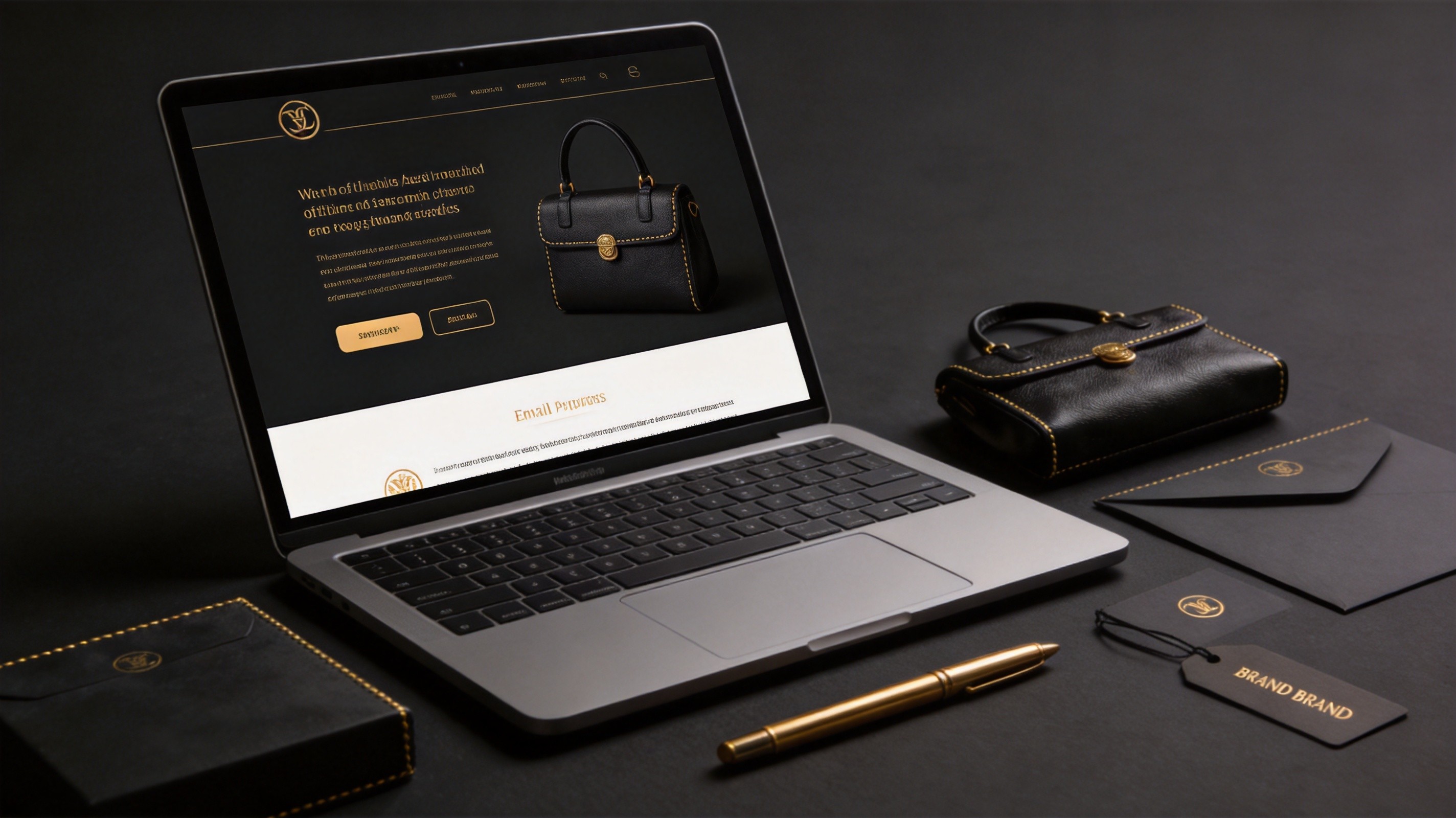
Theme selection sets the visual foundation for your brand's digital presence
Product Page Optimization for Handbags
Product pages are where purchase decisions happen. For handbags, effective product pages combine compelling photography with detailed information that addresses customer questions before they become support tickets or return reasons. Each product page should include: gallery with 6 to 8 images, detailed description covering materials and dimensions, size guide with measurements, customer reviews, related product recommendations, and clear add-to-cart button placement.
Include a "What Fits Inside" section showing common items (phone, wallet, keys, makeup bag) placed inside the bag. This helps customers visualize capacity more effectively than dimensions alone. Add a materials and care section explaining how to maintain the bag. Our product photography guide covers creating images that drive conversions.
Sourcing Handbags for Your Shopify Store

Effective sourcing strategy ensures product quality meets brand standards
Your sourcing strategy directly impacts product quality, pricing flexibility, and inventory management. For Shopify handbag brands, the most common sourcing approach is working directly with factories in China for private label production. This gives you control over design, materials, quality, and branding while maintaining competitive cost structures.
Key considerations when sourcing for Shopify include: ordering quantities that balance cash flow with inventory availability, designing products with your specific customer persona in mind, ensuring quality standards that generate positive reviews and low return rates, and building packaging that creates memorable unboxing experiences. Our manufacturing services support DTC brands with MOQs of 200 pieces per style, custom design, private labeling, and quality control programs.
Inventory Management — Pre-Order vs Stock-Holding
Inventory management is one of the most critical operational decisions for handbag brands on Shopify. Holding inventory requires upfront capital but enables immediate fulfillment and fast shipping. Pre-order models reduce inventory risk but may frustrate customers expecting quick delivery.
Recommended Inventory Strategy
- Core styles: Hold 45 to 60 days of inventory for proven bestsellers
- Seasonal styles: Produce in limited quantities aligned with demand forecasts
- New launches: Start with minimum order (200 pieces) and reorder based on sales velocity
- Pre-order option: Use for limited editions or test designs to gauge demand before production

Smart inventory management balances capital efficiency with customer fulfillment speed
Third-Party Logistics (3PL) for Handbag Fulfillment

3PL fulfillment enables handbag brands to scale without warehouse investment
As your Shopify handbag brand grows beyond 30 orders per day, outsourcing fulfillment to a 3PL becomes more efficient than self-fulfillment. A 3PL handles storage, picking, packing, shipping, and returns processing, freeing you to focus on product development, marketing, and brand building.
| 3PL Provider | Best For | Pick and Pack Cost | Warehouse Locations | Shopify Integration |
|---|---|---|---|---|
| ShipBob | US domestic brands | $3 - $5/order | 40+ US locations | Native |
| Deliverr | Fast shipping focus | $3 - $6/order | Multiple US | Native (Shopify Fulfillment) |
| Red Stag | Premium products | $4 - $7/order | 2 US locations | Native |
| ShipHero | Multi-channel sellers | $3 - $5/order | 6 US locations | Native |
Shipping Strategy — Free Shipping Thresholds and Rates
Shipping costs significantly impact conversion rates and average order value for handbag brands. Offering free shipping above a threshold incentivizes larger orders while maintaining margins. The optimal free shipping threshold is typically 10 to 15 percent above your average order value, encouraging customers to add items to qualify.
For handbag brands with average order values between $80 and $150, a free shipping threshold of $99 to $125 works effectively. Below the threshold, charge a flat shipping rate of $7 to $12 for standard domestic delivery. Use calculated shipping rates through Shopify or flat rates based on order value tiers. Always communicate shipping timelines clearly on product pages and during checkout.
Returns and Exchanges Policy for Handbags
A clear, fair returns policy builds purchase confidence and reduces hesitation. For handbag brands, a 30-day return window with free return shipping is the competitive standard. Your policy should clearly state: return window, condition requirements (unused, tags attached, original packaging), refund method, and process for initiating returns.
Use Shopify apps like Loop Returns or Returnly to automate the return process, offering instant exchanges or store credit as alternatives to refunds. This retains revenue while satisfying customers who want a different style or size. Track return rates by SKU to identify product quality issues that need factory attention. Our quality improvement guide applies equally to DTC operations.
Payment Processing and Currency Options
Shopify Payments (powered by Stripe) is the default payment processor, offering competitive rates of 2.9 percent plus 30 cents per transaction on the Basic plan. Enable additional payment methods including Apple Pay, Google Pay, Shop Pay (Shopify's accelerated checkout), and PayPal to reduce checkout friction. Each additional payment method typically increases conversion by 2 to 5 percent.
For international selling, Shopify Markets enables multi-currency pricing with automatic exchange rate updates. This allows international customers to see prices in their local currency, significantly improving conversion rates for global handbag brands. Transaction fees for international orders through Shopify Payments are 3.4 percent plus 30 cents plus a 1 percent currency conversion fee.
Email Marketing Integration for Handbag Brands
Email marketing generates the highest ROI of any marketing channel for DTC handbag brands. Build your email list through: website popups offering a first-order discount (10 to 15 percent off), checkout email opt-in, social media bio links to landing pages, and content marketing driving traffic to signup-enabled blog posts.
Essential Email Campaigns
- Welcome series: 3 to 5 emails introducing your brand story, bestsellers, and first-order incentive
- Abandoned cart: 2 to 3 emails recovering lost sales with product reminders and time-limited incentives
- Post-purchase: Order confirmation, shipping notification, delivery follow-up with care instructions, and review request
- Seasonal campaigns: New collection launches, holiday gifting guides, and seasonal promotions
- VIP/loyalty: Early access to new products, exclusive discounts, and birthday rewards
Strategic email campaigns drive repeat purchases and customer lifetime value
Social Media Integration — Instagram Shopping and TikTok
Social commerce is increasingly important for handbag brands. Shopify's native integrations with Instagram Shopping, Facebook Shop, TikTok Shopping, and Pinterest Shopping enable seamless product discovery directly from social content. Tag products in Instagram posts and stories, creating shoppable content that drives traffic to your Shopify store.
For TikTok, integrate TikTok Shopping through the Shopify app to enable product links in videos and live streams. TikTok's algorithm favors authentic, behind-the-scenes content showing product creation, styling, and packing processes. This content style resonates strongly with TikTok's audience and drives high engagement for handbag brands. Explore more on marketing strategies in our guide to marketing without a big budget.
Analytics and KPIs to Track
Data-driven decision making separates successful handbag brands from those that stagnate. Track these key performance indicators weekly to identify trends, opportunities, and issues before they become crises.
| KPI | Target Range | How to Measure | Action if Below Target |
|---|---|---|---|
| Conversion rate | 2 - 4% | Shopify analytics | Optimize product pages, improve photography |
| Average order value | $80 - $150 | Shopify analytics | Add bundles, raise free shipping threshold |
| Customer acquisition cost | Under $25 | Ad platform data | Optimize ad targeting, improve organic reach |
| Return rate | Under 10% | Return tracking app | Improve product quality, listing accuracy |
| Repeat purchase rate | 20 - 30% | Shopify customer data | Improve email marketing, loyalty program |
| Gross margin | 50 - 65% | Cost tracking spreadsheet | Negotiate better sourcing, optimize pricing |
Apps and Tools Every Handbag Shopify Store Needs
The Shopify App Store offers thousands of apps. For handbag brands, these are the essential categories and top recommendations: reviews (Judge.me, Loox), email marketing (Klaviyo), SEO (Plug in SEO, Smart SEO), social proof (FOMO, Proof), loyalty (Smile.io, LoyaltyLion), and upselling (ReConvert, Bold Upsell). Each app should directly contribute to increased conversion, higher order values, or improved customer retention.
Scaling from Shopify to Multi-Channel
Once your Shopify store achieves consistent profitability, expand to additional channels to capture new customer segments. Amazon FBA provides access to millions of active shoppers. Wholesale through Faire or direct B2B outreach places your brand in physical retail stores. Pop-up shops and market events create offline brand experiences that drive online sales.
Shopify's multi-channel capabilities sync inventory across all channels from a single dashboard, preventing overselling and simplifying operations. Our factory supports multi-channel brands with production scaling, custom packaging per channel, and the quality consistency that maintains your brand reputation across every sales platform. Connect with us on WhatsApp at +86 17750020688 or email service@junyuanbags.com to discuss your growth plans.
Need Quality Handbags for Your Shopify Brand?
We specialize in supporting DTC handbag brands with custom manufacturing, private labeling, and quality that earns 5-star reviews and repeat customers.
WhatsApp: +86 17750020688 | Email: service@junyuanbags.com
MOQ: 200 pcs/style | Factory: 30,000 sqm, Quanzhou, China
Frequently Asked Questions
What Shopify plan is best for a new handbag brand?
The Basic Shopify plan at $39/month is sufficient for most new brands. Upgrade to Shopify ($105/month) when you need professional reports and lower transaction fees. Advanced ($399/month) is worthwhile only above $20,000 monthly revenue.
Should I hold inventory or use pre-orders?
Hold inventory for core styles and bestsellers. Use pre-orders for limited editions or test designs. Most successful brands hold 30 to 60 days of inventory for proven SKUs.
What 3PL providers work best for handbag brands?
ShipBob and Deliverr lead for US domestic fulfillment with costs of $3-$7 per order. Choose a 3PL with multiple warehouse locations for fast 2-day delivery across the US.
How do I integrate social media shopping with Shopify?
Use Shopify's native integrations for Instagram Shopping, TikTok Shopping, Facebook Shop, and Pinterest Shopping. Enable through the Sales Channels section and sync your product catalog.
What KPIs should I track for my handbag store?
Essential KPIs: conversion rate (2-4%), average order value ($80-150), customer acquisition cost (under $25), return rate (under 10%), repeat purchase rate (20-30%), and gross margin (50-65%).
Limitations and Scope of This Guide
This guide covers building a handbag brand on Shopify, including sourcing from manufacturers, fulfillment setup, and DTC operations. It is based on our experience as a handbag manufacturer in Quanzhou, China, serving brands worldwide since 2004. Key limitations to keep in mind:
- Shopify platform features, pricing, and app recommendations are current as of 2026. Platform capabilities change with updates and new releases.
- This guide focuses on the DTC (direct-to-consumer) model. Wholesale, retail distribution, and marketplace selling require different fulfillment strategies.
- Shipping and logistics recommendations assume US-based fulfillment. International DTC operations involve additional customs, duties, and compliance considerations.
For advice tailored to your specific situation, contact our team directly.