Table of Contents
- The Handbag Distribution Landscape Overview
- Choosing Your Distribution Model: B2B, B2C, or Hybrid
- Market Analysis: Identifying Underserved Segments
- Building Your Product Portfolio for Distribution
- Sourcing Strategy: Factory Direct vs Brand Partnerships
- Warehouse and Logistics Infrastructure
- Pricing Architecture for Distributors
- Sales Channel Strategy: Retail, Online, and Marketplaces
- Building a Sales Team and Representative Network
- Customer Acquisition: Boutiques, Department Stores, and E-commerce
- Inventory Management and Demand Forecasting
- Credit Terms and Accounts Receivable Management
- Marketing Support for Your Retail Partners
- Scaling Your Distribution Operation
- Key Performance Metrics for Distribution Businesses
- FAQ — Handbag Distribution Business
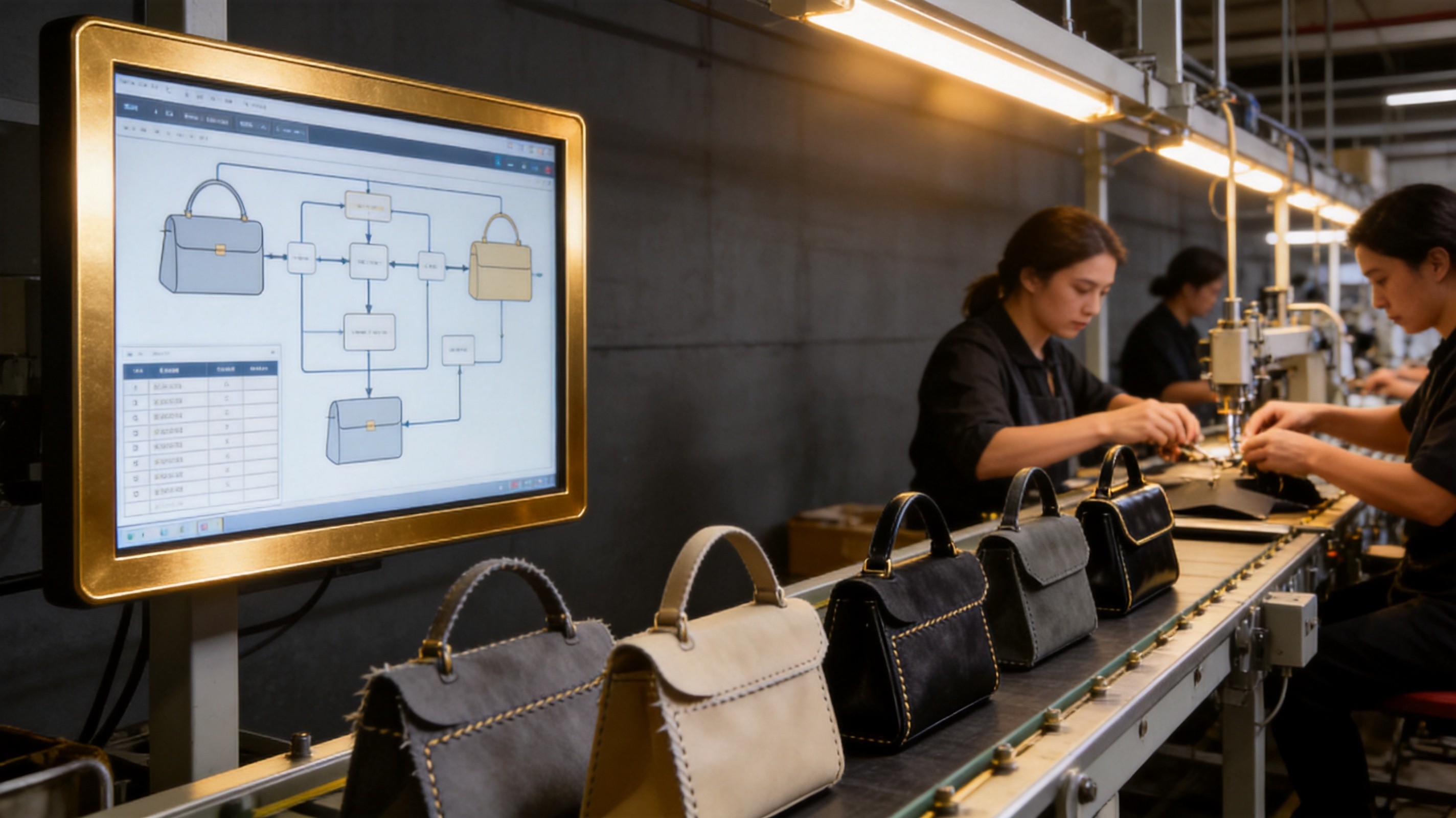
Data-driven decision making separates profitable distributors from those struggling with margins
The handbag distribution business sits at the critical intersection between manufacturing and retail, connecting factories that produce quality products with retailers who need curated assortments for their customers. A well-run distribution business generates attractive margins through volume efficiency, market knowledge, and relationship capital. The global handbag market, projected to exceed $380 billion by 2027, provides ample opportunity for distributors who can serve retail partners effectively.
This guide provides a comprehensive framework for building a handbag distribution business from the ground up or optimizing an existing operation. We cover distribution models, sourcing strategies, warehouse infrastructure, sales channel development, pricing architecture, and the key performance metrics that drive profitability. Whether you are launching a new distribution company or scaling an existing one, these strategies provide the operational foundation for sustainable growth. For manufacturers looking to understand their distribution partners better, our manufacturing services page outlines how factory-direct partnerships work within distribution models.

A well-organized distribution warehouse is the operational backbone of a profitable handbag distribution business
The Handbag Distribution Landscape Overview
The handbag distribution industry serves as the connective tissue between manufacturers and retailers. Distributors purchase handbags from factories or brand owners, warehouse them, and resell to retail stores, e-commerce platforms, and other channels at a markup that covers their operating costs and generates profit. The distributor's value lies in market knowledge, inventory availability, credit extension, logistics efficiency, and retail relationships.
The industry has evolved significantly in recent years. Traditional distribution models focused on geographic territories and exclusive brand representation are giving way to more flexible, multi-channel approaches. Digital tools have transformed order management, inventory tracking, and customer communication. The most successful modern distributors combine deep product expertise with operational efficiency and technology-enabled service to create value for both their suppliers and retail customers.
Choosing Your Distribution Model: B2B, B2C, or Hybrid
Your distribution model determines your customers, operations, margin structure, and growth trajectory. Each model has distinct characteristics and requirements.
| Model | Customers | Avg Margin | Key Advantage | Key Challenge |
|---|---|---|---|---|
| B2B Wholesale | Retail stores, dept. stores | 25-40% | Volume efficiency, predictable demand | Credit risk, seasonal fluctuation |
| B2C E-commerce | End consumers | 50-65% | Higher margins, direct data | Marketing cost, fulfillment complexity |
| Hybrid B2B/B2C | Both retail and consumer | 35-55% | Revenue diversification | Channel conflict, operational complexity |
| Marketplace | Platform customers | 20-35% | Platform traffic, easy entry | Platform fees, limited control |
For new distributors, starting with a B2B wholesale model focused on a specific niche or geographic market provides the clearest path to profitability. As you build supplier relationships and retail customer base, expanding into hybrid or additional channels creates growth opportunities. Our analysis of global market trends helps identify the most promising market segments for new distribution businesses.

Tracking growth metrics helps distributors identify the most profitable expansion opportunities
Market Analysis: Identifying Underserved Segments
Successful distribution businesses serve market segments where demand exists but supply is underserved. This could be geographic regions with insufficient distribution coverage, retail channels that lack product access, price points with inadequate quality options, or style categories where retailers struggle to find suitable products.
Conduct market analysis by mapping existing distribution coverage in your target market, identifying retail stores that lack adequate handbag sourcing options, analyzing product gaps at trade shows, surveying potential retail customers about unmet needs, and studying competitor weaknesses. The best market opportunities exist where you can solve a specific problem for retailers: providing faster delivery than competitors, offering exclusive products they cannot find elsewhere, filling a price-quality gap in their assortment, or providing superior service and support.
Building Your Product Portfolio for Distribution
Your product portfolio is your primary competitive asset. It must offer retailers a compelling reason to purchase from you rather than competing distributors or direct from factories. A well-built portfolio balances breadth (enough variety to serve diverse retailer needs) with depth (sufficient stock of proven sellers to ensure reliable availability).
Structure your portfolio around proven selling categories: everyday totes and work bags (25-30 percent of portfolio), crossbody bags (20-25 percent), shoulder bags (15 percent), clutches and evening bags (10 percent), backpacks and convertibles (10 percent), and mini bags and accessories (10-15 percent). Within each category, offer multiple price points and styles to serve retailers at different market positions. For product inspiration, explore our product catalog covering all major handbag categories.

A strategically built product portfolio serves diverse retail customers across multiple categories and price points
Sourcing Strategy: Factory Direct vs Brand Partnerships
Your sourcing strategy determines your cost structure, product exclusivity, and supply chain reliability. Distributors typically source through two primary channels: direct factory relationships for private label or unbranded products, and brand partnership agreements for established branded lines.
Factory-direct sourcing offers the highest margins (35-45 percent) and full product control but requires larger minimum orders and more operational management. Brand partnerships offer lower margins (20-30 percent) with established products and marketing support but less differentiation from competitors. The optimal strategy for most distributors combines both approaches: factory-direct for core products where you want maximum margin and exclusivity, supplemented by selective brand partnerships for variety and market credibility.
When sourcing factory-direct from manufacturers like Junyuan Bags in Quanzhou, with 20+ years of experience and a 30,000 square meter facility, you gain access to the manufacturing expertise and capacity needed for consistent, reliable supply. Our factory capabilities support distributors with production volumes ranging from 200-piece minimum orders to large-scale container shipments.
Warehouse and Logistics Infrastructure
The warehouse is the operational heart of a distribution business. Its efficiency directly impacts order accuracy, shipping speed, and operating costs. Design your warehouse infrastructure to support your projected volume while maintaining flexibility for growth.
- Space requirements: Start with 1,000-2,000 sq ft, scaling to 5,000-10,000 sq ft as volume grows
- Storage systems: Industrial shelving rated for boxed handbag storage, organized by SKU and season
- Packing stations: Dedicated areas for order picking, quality check, packing, and label application
- Shipping setup: Loading dock or ground-level access, carrier pickup arrangements
- Climate control: Temperature and humidity management to protect leather and materials
- Inventory system: Barcode-based tracking with real-time stock visibility across all SKUs
Pricing Architecture for Distributors
Pricing architecture determines your margin at every level of the distribution chain. A clear, structured pricing system ensures profitability while remaining competitive and fair to retail partners.
| Pricing Level | Typical Markup | Target Customer | Margin to Distributor |
|---|---|---|---|
| Factory Cost | Base | N/A | N/A |
| Distributor Landed Cost | +15-25% (shipping, duty) | N/A | N/A |
| Wholesale Price | +35-50% over landed | Retail stores | 25-40% gross margin |
| Retail Price | +100-150% over wholesale | End consumer | N/A (retailer's margin) |
| Volume Discount Tiers | 5-15% off wholesale | Large accounts | 15-30% (still profitable) |
Implement clear volume discount tiers that reward larger orders while maintaining profitability. A typical structure offers 5 percent discount for orders over $1,000, 10 percent for orders over $2,500, and 15 percent for orders over $5,000. These discounts incentivize larger orders that reduce your per-order processing costs while keeping margins above your minimum threshold. For detailed negotiation strategies, see our guide on price negotiation strategies.
Sales Channel Strategy: Retail, Online, and Marketplaces
A multi-channel sales strategy maximizes market reach while diversifying revenue sources. Each channel serves different customer segments and carries distinct operational requirements.
Independent boutiques represent the core channel for most handbag distributors, offering personalized service, consistent reorder patterns, and loyalty once established. Department stores and chain retailers provide higher volume per order but demand stricter compliance, larger inventory commitments, and extended payment terms. E-commerce platforms and B2B websites enable 24/7 ordering convenience for retailers who prefer digital purchasing. Trade shows provide concentrated selling opportunities and new customer acquisition. Building presence across multiple channels ensures revenue stability if any single channel experiences disruption.

Trade shows and personal relationships remain the most effective channels for distributor-retailer connections
Building a Sales Team and Representative Network
Your sales team is the revenue engine of your distribution business. The right sales structure matches your target market, geographic coverage, and growth stage. Early-stage distributors typically rely on founder-led sales supplemented by trade show presence. As volume grows, adding dedicated sales representatives or independent rep agencies expands your reach.
Independent sales representatives offer the most cost-effective coverage for geographic expansion. They work on commission (typically 5-10 percent of sales), carry multiple non-competing lines, and have established relationships with retail buyers in their territories. This model allows you to cover multiple markets without the fixed cost of salaried employees. As specific markets reach critical volume, convert independent coverage to dedicated sales staff for deeper market penetration.
Customer Acquisition: Boutiques, Department Stores, and E-commerce
Acquiring retail customers requires a systematic approach combining proactive outreach, trade show presence, digital marketing, and referral generation. The most effective customer acquisition strategies for handbag distributors include multiple touchpoints over time.
Build a target customer list by researching independent boutiques, department stores, and e-commerce retailers in your target market. Attend trade shows where these buyers shop for new lines. Send professionally designed line sheets and catalogs to qualified prospects. Follow up with personal visits or video calls to present your collection. Offer attractive first-order terms to reduce the risk of trial. Deliver exceptional service on every order to generate referrals and repeat business. Customer lifetime value in distribution is substantial: a loyal retail account typically generates $5,000 to $50,000 annually in recurring orders over many years.
Inventory Management and Demand Forecasting
Inventory management is the single most impactful operational function in a distribution business. Too much inventory ties up capital and increases markdown risk. Too little inventory means missed sales and frustrated customers. The goal is maintaining optimal stock levels that maximize sales while minimizing capital commitment.
Implement ABC analysis to prioritize inventory investment: A-items (top 20 percent of SKUs generating 80 percent of revenue) should always be in stock with 4 to 6 weeks of supply. B-items (next 30 percent of SKUs) should maintain 2 to 4 weeks of supply with reorder triggers. C-items (bottom 50 percent) should be stocked conservatively with 1 to 2 weeks of supply or ordered to demand. Review inventory performance monthly and adjust stock levels based on actual sell-through data.
Credit Terms and Accounts Receivable Management
Extending credit to retail customers is both a competitive necessity and a financial risk. Offering net 30 or net 60 payment terms differentiates you from competitors who require prepayment, but it also creates accounts receivable exposure that must be managed actively.
Credit Management Framework
Establish clear credit policies: credit applications for all new accounts, credit limits based on financial review (start conservative at $1,000-$3,000 and increase with proven payment history), net 30 terms as standard with net 60 available for established accounts, early payment discounts (2/10 net 30) to incentivize prompt payment, and active collections follow-up at 15, 30, and 45 days past due.
Marketing Support for Your Retail Partners
The best distributors do not just sell products; they help their retail partners sell more effectively. Providing marketing support increases your retailers' success, which drives higher reorder rates and strengthens the partnership relationship.
Marketing support offerings include professional product photography and lifestyle imagery that retailers can use in their own marketing, display materials and fixtures designed for your products, digital marketing assets for social media and email campaigns, product training materials for retail sales staff, and co-op advertising programs that share the cost of local marketing. These investments in your retail partners' success generate returns through increased sell-through, faster inventory turnover, and stronger loyalty.

Providing marketing support to retail partners increases sell-through and strengthens distribution relationships
Scaling Your Distribution Operation
Scaling a distribution business requires systematic investment in infrastructure, people, and processes. The transition from founder-led operation to scalable business involves building systems that function independently of any single person's direct involvement.
Key scaling milestones include implementing an ERP or inventory management system that automates ordering and fulfillment, hiring a warehouse manager to oversee operations, building a sales team that generates revenue without founder involvement, establishing supplier relationships that provide consistent quality and delivery, and developing financial systems for cash flow management at higher volumes. Plan scaling investments based on revenue milestones rather than timeframes. When revenue consistently reaches the capacity of your current infrastructure, invest in the next level of systems and personnel.
Key Performance Metrics for Distribution Businesses
Distribution businesses live and die by their metrics. Tracking the right KPIs weekly and monthly provides early warning of problems and identifies opportunities for improvement before they impact profitability.
| KPI | Target Range | Measurement Frequency | Action Threshold |
|---|---|---|---|
| Gross Margin | 30-45% | Monthly | Below 25% requires pricing review |
| Inventory Turnover | 4-6x annually | Monthly | Below 3x indicates overstocking |
| Days Sales Outstanding | 30-45 days | Weekly | Above 60 days requires collection action |
| Order Fill Rate | 95-98% | Weekly | Below 90% requires inventory review |
| Customer Retention Rate | 80-90% | Quarterly | Below 70% requires relationship review |
| Return Rate | 2-5% | Monthly | Above 8% indicates quality issues |
Monitor these metrics consistently and take corrective action when thresholds are breached. The distributors who excel at operational discipline consistently outperform those who rely on sales volume alone to drive profitability. For quality control support from the manufacturing side, our guide on ensuring quality consistency helps reduce returns and protect margins.
Your Reliable Handbag Manufacturing Partner
Junyuan Bags supports distributors with consistent quality, reliable delivery, and competitive pricing. Our 20+ years of manufacturing expertise and 30,000 sqm factory ensure the supply reliability your distribution business depends on.
WhatsApp: +86 17750020688 | Email: service@junyuanbags.com
MOQ: 200 pcs/style | Factory: 300+ workers, Quanzhou, China
Frequently Asked Questions
How much capital is needed to start a handbag distribution business?
Typical startup capital ranges from $50,000 to $200,000, covering initial inventory ($25K-$100K), warehouse setup ($5K-$20K), licensing ($1K-$3K), shipping setup ($3K-$8K), marketing ($2K-$5K), and working capital reserve ($15K-$50K). Requirements vary based on private label versus branded distribution focus.
What are typical distributor profit margins?
Gross margins range from 25-45% depending on the model. Private label distribution achieves 35-45%, while branded distribution operates on 20-30%. Net profit margins after expenses typically range from 8-18%. The most profitable distributors combine private label products with selective branded lines.
How do you find retail partners?
Multi-channel approach: trade shows (MAGIC, LASSEM, NY NOW), sales representative networks, cold outreach to qualified retailers, B2B e-commerce platforms, and referral relationships. Effective customer acquisition combines multiple touchpoints over time with exceptional service to generate loyalty and referrals.
What warehouse requirements does distribution need?
Start with 1,000-2,000 sq ft of clean, climate-controlled space with industrial shelving, packing stations, loading access, and barcode-based inventory tracking. Scale to 5,000-10,000 sq ft as volume grows. Temperature and humidity control is essential for leather and material preservation.
What is the most profitable distribution model?
The most profitable model combines private label products (35-45% margins) with multi-channel distribution to independent boutiques, department stores, and B2B e-commerce. Adding value-added services like merchandising support and marketing materials increases partner loyalty and order frequency.
Limitations and Scope of This Guide
This guide covers building a handbag distribution business, including brand partnerships, logistics, territory management, and growth strategies. It is based on our experience as a handbag manufacturer in Quanzhou, China, serving brands worldwide since 2004. Key limitations to keep in mind:
- Distribution margin benchmarks are based on US and European markets. Margins in emerging markets (Southeast Asia, Middle East, Africa) may differ significantly.
- Legal and contractual guidance is general in nature. Distribution agreements should be reviewed by qualified legal counsel in your specific jurisdiction.
- This guide focuses on physical product distribution. Digital-first brands with showrooms and e-commerce may follow different distribution models.
For advice tailored to your specific situation, contact our team directly.