Table of Contents
- The Rise of Minimalist Carry: Why Card Holders Are Outselling Wallets
- Market Data: Card Holder Growth vs Traditional Wallets
- Key Design Trends Shaping 2026 Card Holders
- Slim Profile Engineering: Fitting More in Less Space
- Material Innovation: Beyond Traditional Leather
- Metal Card Holders: Titanium, Aluminum, and Carbon Fiber
- Smart Card Holders: Tech Integration and Connectivity
- Sustainable and Vegan Material Options
- Pop-Up and Mechanism-Based Card Holders
- Card Holder Capacity: Finding the Sweet Spot
- RFID Protection in Minimalist Designs
- Money Clips and Cash Strap Solutions
- Personalization and Customization Options
- Packaging and Unboxing Experience for Premium Card Holders
- Production Considerations for Card Holder Brands
- FAQ — Card Holder Design Trends 2026
The card holder has quietly overtaken the traditional wallet as the fastest-growing segment in personal carry accessories. Driven by the global shift toward cashless payments, the minimalist lifestyle movement, and a consumer desire for products that are both functional and aesthetically refined, card holders now represent over 20 percent of the wallet and card accessory market and growing at three times the rate of traditional wallet categories. For brands, this shift represents both an opportunity and a challenge: the design canvas is smaller, the margins are higher, and the competition is intensifying rapidly.
This guide examines the design trends shaping the card holder market in 2026, from material innovation and engineering breakthroughs to smart technology integration and sustainability requirements. Whether you are launching a new card holder brand, expanding an existing leather goods line, or refreshing your product assortment with current designs, these insights provide the foundation for product decisions that align with where the market is heading, not where it has been. Our custom manufacturing services cover every card holder style discussed in this guide.
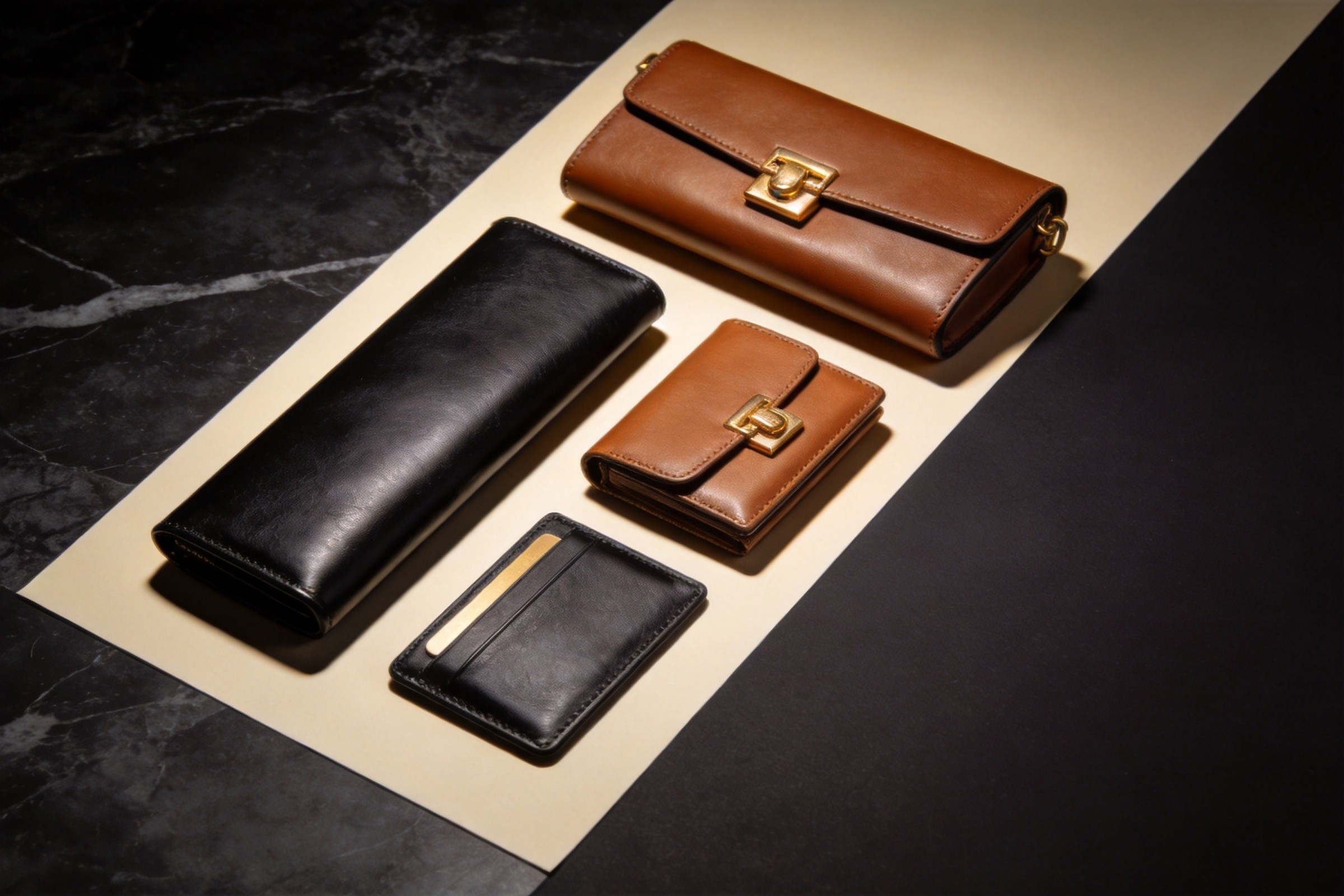
The card holder market in 2026 spans traditional leather, precision metal, and innovative sustainable materials
The Rise of Minimalist Carry: Why Card Holders Are Outselling Wallets
The minimalist carry movement is not a fleeting trend. It is a fundamental shift in how people think about everyday essentials, driven by the convergence of digital payments, smaller pocket technology (smartphones replacing keys, wallets, and music players), and a cultural preference for intentionality over accumulation. The average millennial and Gen Z consumer carries 3 to 5 cards and uses cash less than 15 percent of the time, making a full-size wallet with fifteen card slots and a bill compartment functionally excessive.
This behavioral shift has direct implications for product design. A card holder that holds 5 to 7 cards, features a quick-access exterior slot, and maintains a profile under 10mm thick when loaded meets the practical needs of the majority of daily users. It also delivers aesthetic benefits: a slim card holder creates no pocket bulge, pairs seamlessly with tailored clothing, and projects a modern, intentional image that resonates with style-conscious consumers. The cultural appeal of minimalism, amplified by social media aesthetics and influencer lifestyles, adds emotional motivation to the functional rationale.
For brands, the minimalist card holder category offers an exceptional entry point. Manufacturing costs are lower than traditional wallets, the design canvas rewards precision and attention to detail, and the price-to-cost ratio supports strong margins. For brands exploring the broader wallet market, our complete wallet buying guide explains how card holders fit within the broader product category landscape.
Market Data: Card Holder Growth vs Traditional Wallets
The data tells a clear story of category shift. While the overall wallet market grows at 5 to 6 percent annually, card holders specifically are growing at 15 to 18 percent per year. Meanwhile, traditional multi-fold wallets are growing at only 2 to 3 percent, and tri-fold wallets are declining at 1 to 2 percent annually. This divergence is expected to accelerate through 2028 as contactless payment adoption continues to increase globally.
| Category | 2024 Market Share | 2026 Projected | Growth Rate | Avg Margin |
|---|---|---|---|---|
| Card Holders | 22% | 28% | 15-18% | 65-75% |
| Bi-Fold Wallets | 38% | 35% | 2-3% | 55-65% |
| Zip-Around Wallets | 12% | 13% | 5-7% | 60-70% |
| Tri-Fold Wallets | 13% | 11% | -1 to -2% | 50-60% |
| Long Wallets | 7% | 6% | 0-1% | 55-65% |
| Others | 8% | 7% | 2-4% | 55-70% |
The card holder segment's 15 to 18 percent annual growth rate is driven by multiple factors: new consumers entering the market who never adopted traditional wallets, existing wallet users downsizing their carry, and the replacement purchase cycle as consumers refresh accessories more frequently. The average card holder replacement cycle is 18 to 24 months, compared to 3 to 5 years for traditional leather wallets, creating more frequent repurchase opportunities for brands.
Key Design Trends Shaping 2026 Card Holders
The card holder design landscape in 2026 is defined by five major trends that collectively represent the direction of the market. Understanding these trends helps brands make design decisions that feel current and forward-looking rather than retrograde.
First, ultra-slim engineering continues to push the boundaries of what is possible. Designers are finding ways to hold the same number of cards in progressively thinner profiles through innovative slot geometry and material selection. Second, material diversification has accelerated dramatically, with metal, carbon fiber, and sustainable alternatives challenging leather's traditional dominance. Third, mechanism-based designs featuring pop-up card ejection systems have moved from novelty to mainstream, with multiple price points and material options. Fourth, smart technology integration is beginning to appear, with Bluetooth tracking chips and NFC-enabled designs entering the market. Fifth, sustainability has transitioned from a nice-to-have to a purchasing requirement for significant consumer segments.
Ultra-slim engineering allows modern card holders to hold more cards in less space than ever before
Slim Profile Engineering: Fitting More in Less Space
The engineering challenge at the heart of card holder design is how to maintain adequate card capacity while minimizing the overall thickness of the loaded product. Traditional stacked card slot designs add thickness linearly: each additional card increases the profile by approximately 1mm. Innovative approaches in 2026 break this linear relationship through several engineering techniques.
Overlapping slot designs use staggered card positions that share space rather than stacking directly. When viewed from the edge, cards are arranged in a fan pattern rather than a straight stack, reducing total thickness by 20 to 30 percent compared to traditional designs. Stretch-pocket designs use elastic panels that conform to the number of cards inserted, maintaining a consistent external profile whether holding 3 or 7 cards. Precision-milled aluminum designs use exact tolerances that eliminate wasted space, with card channels machined to within 0.1mm of the card thickness.
| Design Approach | Thickness (5 cards) | Complexity | Best Material |
|---|---|---|---|
| Traditional Stacked Slots | 12-15mm | Low | Leather |
| Overlapping Fan Slots | 8-11mm | Medium | Leather, PU |
| Stretch Pocket | 7-10mm | Medium | Elastic fabric, leather hybrid |
| Precision Milled Channels | 6-8mm | High | Aluminum, titanium |
| Pop-Up Mechanism | 8-12mm | High | Aluminum, carbon fiber |
These engineering advances are not merely technical achievements. They translate directly to consumer satisfaction and product reviews. A card holder that maintains a slim profile even when fully loaded receives consistently higher ratings and generates more positive word-of-mouth than a design that bulges unpleasantly. For brands, investing in pattern engineering and prototyping to achieve the slimmest possible profile is one of the highest-return design investments available.
Material Innovation: Beyond Traditional Leather
While leather remains the most popular card holder material, 2026 sees an unprecedented diversification of material options. Each new material brings distinct aesthetic qualities, manufacturing requirements, and brand positioning opportunities. The expanding material palette allows brands to differentiate themselves more clearly in an increasingly crowded market.
Beyond traditional leather, the most significant material innovations include aerospace-grade aluminum machined from solid billet for precision-engineered holders. Grade 5 titanium offering the highest strength-to-weight ratio for ultra-premium positioning. Woven carbon fiber providing a distinctive technical aesthetic with excellent durability. Recycled ocean-bound plastics transformed into durable sheets for sustainability-focused brands. Cork fabric harvested from cork oak trees as a natural, renewable alternative. And plant-based leather alternatives made from pineapple leaf fiber, mushroom mycelium, and apple peel composite that are increasingly indistinguishable from animal leather in appearance and performance.
Metal Card Holders: Titanium, Aluminum, and Carbon Fiber
Metal card holders have carved out a significant and growing segment of the market, appealing to consumers who value precision engineering, modern aesthetics, and exceptional durability. The metal holder category is led by aluminum 6061-T6, which offers the best balance of machinability, weight, and cost. CNC-machined aluminum holders feature precise card channels, chamfered edges, and anodized finishes in a wide range of colors.
Titanium holders represent the luxury tier, offering 40 percent less weight than steel with superior corrosion resistance and a distinctive gunmetal aesthetic. The material cost is significantly higher than aluminum, positioning titanium holders at $80 to $200+ retail. Carbon fiber holders combine lightweight construction with a woven pattern that is instantly recognizable, appealing to the technology enthusiast and automotive enthusiast demographics.
Metal card holders appeal to consumers who value precision engineering and modern aesthetic
Manufacturing metal card holders requires fundamentally different production capabilities than leather goods. CNC machining centers, anodizing or PVD coating facilities, and precision quality control equipment are essential. Many brands choose to partner with specialized metal working factories rather than traditional leather workshops. Junyuan Bags coordinates both leather and metal production capabilities to offer brands a unified sourcing solution. Contact our team to discuss your material requirements.
Smart Card Holders: Tech Integration and Connectivity
The smart card holder represents the frontier of the category, integrating technology that extends the product's functionality beyond simple card storage. While still a niche segment, smart features are gaining attention and are expected to move toward mainstream adoption as component costs decrease and consumer familiarity increases.
The most common smart feature is Bluetooth tracking, using a small coin-cell-powered module that connects to smartphone finding networks. This feature addresses a genuine pain point: card holders are compact enough to be easily misplaced, and the anxiety of losing all cards in a small wallet is real. The tracking module adds approximately $3 to $8 in component cost and supports a retail price premium of 25 to 40 percent. NFC-enabled card holders that store digital business cards or social profiles represent another emerging feature, though adoption is slower due to smartphone dependency.
Sustainable and Vegan Material Options
Sustainability has moved from marketing buzzword to genuine purchasing criterion for a growing consumer segment. In 2026, approximately 35 percent of card holder buyers under age 35 actively seek out sustainable or vegan alternatives to traditional leather, and this percentage is growing at 8 to 10 percent annually.
The sustainable material landscape includes several viable options. Cork fabric, harvested from cork oak bark without harming the tree, offers a unique textured appearance and natural water resistance. Pinatex, made from pineapple leaf fibers, provides a leather-like appearance with a compelling agricultural waste story. Mushroom mycelium leather, grown from fungal root structures, creates a biodegradable material that can be formed to specific shapes. Recycled plastics, including ocean-recovered PET, are transformed into durable sheets suitable for card holder construction. Each material carries different manufacturing requirements, cost structures, and aesthetic qualities.
Sustainable Material Comparison 2026
Cork: $6-12/sqft, natural texture, water-resistant. Pinatex: $8-15/sqft, leather-like, agricultural waste story. Mycelium: $10-18/sqft, biodegradable, cutting-edge. Recycled PET: $4-8/sqft, consistent, scalable. Vegetable-tanned leather: $8-18/sqft, traditional premium, eco-friendly tanning.
Pop-Up and Mechanism-Based Card Holders
Pop-up card holders have evolved from a single brand's novelty into a widely available design category with options at every price point. The mechanism, typically a spring-loaded lever that fans cards upward for easy selection, adds a satisfying tactile interaction that differentiates these holders from passive designs.
The engineering requirements for pop-up mechanisms are significant. The mechanism must operate reliably through thousands of cycles, hold cards securely during normal carrying, and add minimal thickness. Leading designs use aluminum housings with stainless steel springs and elastic band retention systems. The best mechanisms operate with a single fluid motion and produce a satisfying mechanical click that reinforces the perception of quality.

Pop-up mechanisms add satisfying tactile interaction that differentiates card holders from passive designs
For brands, pop-up holders offer a compelling combination of higher perceived value, differentiation from simple leather designs, and the ability to command premium pricing. The manufacturing complexity is higher, requiring coordination between metal machining, spring assembly, and quality testing. MOQs for mechanism-based holders are typically higher due to the custom tooling required, often 500 pieces per style.
Card Holder Capacity: Finding the Sweet Spot
The capacity question is central to card holder design. Too few slots and the product fails practical requirements. Too many and it sacrifices the slim profile that defines the category. Market research consistently identifies the sweet spot at 5 to 7 total card positions, including 1 to 2 quick-access exterior slots and 4 to 5 internal storage positions.
This range accommodates the statistically documented average daily carry of 3.7 payment cards plus 1.2 identification cards for the typical consumer. The 1 to 2 quick-access positions handle the most frequently used cards, while the internal positions provide secure storage for less frequently needed items. Adding a cash strap or money clip for 3 to 5 bills addresses the occasional cash need without requiring a dedicated bill compartment.
RFID Protection in Minimalist Designs
RFID protection in card holders presents unique design considerations compared to traditional wallets. The compact size of card holders means the RFID-blocking layer must cover a smaller area, reducing material cost. However, the slim profile requirement means the shielding material must be as thin as possible without compromising effectiveness.
For metal card holders, the metal housing itself provides natural RFID shielding, making additional material unnecessary. For leather and fabric designs, ultra-thin copper-nickel mesh at 0.2mm adds minimal thickness while providing complete blocking. Given that 68 percent of consumers consider RFID protection important, including it in card holder designs is essentially mandatory for brands competing in the premium segment. The cost impact is minimal at $0.50 to $1.50 per unit while supporting a meaningful price premium and marketing story.
Money Clips and Cash Strap Solutions
The integration of cash storage solutions into minimalist card holders addresses the reality that cash is still used in many daily transactions, even as frequency declines. The two dominant approaches are the money clip and the cash strap, each with distinct advantages.
Money clips, either integrated into the card holder's frame or added as a separate plate, use spring tension to secure bills flat against the back of the holder. This approach adds minimal thickness and keeps bills organized and accessible. Cash straps use an elastic band that wraps around the holder and bills together, offering a more flexible solution that accommodates varying numbers of bills. The cash strap approach is simpler and less expensive but less refined in appearance.
Cash storage solutions integrate seamlessly into card holder designs for complete everyday carry
Personalization and Customization Options
Card holders are uniquely suited to personalization due to their compact size and the intimate nature of the product. A personalized card holder feels uniquely owned, making it the most popular gift item in the accessories category. Brands that offer personalization services capture 25 to 35 percent higher margins and experience significantly lower return rates.
The personalization options for card holders include laser engraving of names, initials, or dates on metal and leather surfaces. Debossing of monograms on leather models. Custom color selection for anodized metal holders. Interchangeable face plates that allow aesthetic customization. Engraved patterns, geometric designs, or artwork for limited edition releases. Corporate logo placement for B2B gifting programs. The personalization infrastructure requires either laser marking equipment or a set of individual letter dies for debossing, both manageable investments for established manufacturers.
Packaging and Unboxing Experience for Premium Card Holders
The unboxing experience for premium card holders must match the product's quality positioning. Given that card holders are frequently purchased as gifts, packaging serves a dual purpose: protecting the product during shipping and creating a presentation that justifies the price point before the holder is even removed from its box.
The premium card holder packaging standard includes a rigid magnetic-closure box with custom foam or molded pulp insert, a microfiber protective pouch for the holder itself, a brand story card explaining materials and craftsmanship, and care instructions. For the luxury tier, consider adding a material sample swatch showing the raw material before finishing, a certificate of authenticity for exotic materials, or a QR code linking to a video of the manufacturing process.
Production Considerations for Card Holder Brands
Manufacturing card holders presents a different set of considerations than traditional wallet production. The smaller size means less material waste but also less margin for error in cutting and assembly. The slim profile requires precise material thickness control. And the variety of materials, from leather to metal to carbon fiber, may require multiple production partners or a factory with diverse capabilities.
For leather card holders, the standard production approach involves precision die-cutting of components, skiving edges for reduced thickness at fold points, adhesive assembly of layers before stitching, and careful edge finishing. For metal holders, CNC machining from billet stock, deburring, surface finishing (anodizing, PVD coating, or brushing), and mechanical assembly. Quality control focuses on dimensional accuracy, surface finish consistency, and mechanism reliability for pop-up designs.
Card Holder Production Cost by Material and Feature
| Material / Feature | FOB Cost Range (200 pcs) | FOB Cost Range (1000+ pcs) | Key Considerations |
|---|---|---|---|
| Top-Grain Leather | $3.50 - $6.00 | $2.80 - $5.00 | Best balance of quality and cost; ideal for mid-range brands |
| Full-Grain Leather | $5.00 - $9.00 | $4.00 - $7.50 | Premium positioning; develops patina over time |
| PU Leather | $1.50 - $3.00 | $1.00 - $2.50 | Budget-friendly; good for entry-level lines |
| Metal (Aluminum) | $4.00 - $8.00 | $3.50 - $7.00 | Requires CNC machining; premium modern aesthetic |
| Carbon Fiber | $6.00 - $12.00 | $5.00 - $10.00 | Ultra-lightweight; tech-forward positioning |
| RFID-Blocking Lining | +$0.80 - $1.50 | +$0.60 - $1.20 | Add-on to any base material; strong consumer demand |
| Pop-Up Mechanism | +$1.50 - $3.00 | +$1.00 - $2.50 | Precision assembly required; higher defect rate risk |
| Custom Logo Deboss | +$0.30 - $0.80 | +$0.20 - $0.50 | Hot stamping or laser engraving options available |
Brands launching card holder lines benefit from partnering with manufacturers who understand both the precision requirements of slim accessory design and the aesthetic standards of the premium market. With 200-piece MOQs and capabilities spanning both leather and alternative materials, our production capabilities are designed to support brands at every stage from initial launch to volume growth.
Create Your Card Holder Collection
From premium leather to precision metal, Junyuan Bags manufactures card holders that define minimalist excellence. 20+ years expertise, 200-piece MOQ, full customization.
WhatsApp: +86 17750020688 | Email: service@junyuanbags.com
Factory: 30,000 sqm, 300+ workers, Quanzhou, China
Frequently Asked Questions
What is the optimal card capacity for a modern card holder?
The optimal capacity is 5 to 7 total card positions: 1-2 quick-access exterior slots and 4-5 internal storage positions. This accommodates the average daily carry of 3-4 payment cards plus 1-2 IDs while maintaining the slim profile that defines the category.
What is the best material for slim card holders in 2026?
For premium leather brands, full-grain veg-tanned leather at 0.8-1.0mm. For technology-forward brands, Grade 5 titanium or CNC-machined aluminum 6061-T6. For sustainability-focused brands, cork fabric or recycled carbon fiber. The fastest-growing segment is aluminum pop-up mechanism holders.
Are metal card holders better than leather?
Neither is objectively better; they serve different preferences. Metal offers superior protection, modern aesthetics, natural RFID blocking, and decades of durability. Leather offers traditional warmth, personalization, patina development, and lighter weight. The market is approximately 55% leather and 45% metal/alternatives, with metal growing faster.
Can minimalist card holders include RFID protection?
Absolutely. Metal holders provide natural RFID shielding through their housing. Leather holders use ultra-thin copper-nickel mesh at just 0.2mm thickness. The cost impact is minimal ($0.50-$1.50 per unit) while 68% of consumers consider RFID protection important.
What personalization options are available for card holders?
Popular options include laser engraving (names, initials, dates), debossed monograms on leather, custom anodized colors for metal, interchangeable face plates, engraved patterns for limited editions, and corporate logo placement. Personalization drives 25-35% higher margins and reduces return rates.
How does the cost of manufacturing card holders compare to wallets?
Card holders cost significantly less to manufacture, typically $4-$12 per unit for leather designs and $6-$18 for metal designs, compared to $8-$22 for traditional wallets. This lower cost combined with strong retail pricing ($25-$120) yields the highest margins in the personal carry category at 65-75%.
Limitations and Scope of This Guide
This guide covers 2026 card holder design trends focusing on minimalist aesthetics and functional features for fashion brands. It is based on our experience as a handbag manufacturer in Quanzhou, China, serving brands worldwide since 2004. Key limitations to keep in mind:
- Design trends reflect market observations through early 2026. Consumer preferences evolve quickly, especially in the fast-moving accessories segment.
- This guide focuses on standalone card holders and slim wallets. Multi-functional designs (phone cases with card slots, travel organizers) require different design approaches.
- Material recommendations are based on mainstream market expectations. Luxury positioning may require exotic materials or artisan techniques not covered in this overview.
For advice tailored to your specific situation, contact our team directly.