Table of Contents
- Understanding Handbag Cost Structure
- Factors That Influence Wholesale Handbag Pricing
- How to Calculate Target Landed Cost
- Preparation Before Negotiation: Research and Data
- Building Leverage: Volume, Frequency, and Relationships
- Negotiation Tactics That Actually Work with Factories
- When to Push for Price vs When to Accept
- Negotiating Beyond Price: Payment Terms, Shipping, and Extras
- Handling Price Increases and Raw Material Fluctuations
- Multi-Factory Bidding Strategies
- Long-Term Contracts vs Spot Purchasing
- Quality-Price Trade-Offs: When Cheaper Costs More
- Currency Exchange Considerations for International Orders
- Documenting Agreements and Avoiding Misunderstandings
- Building Win-Win Supplier Relationships
- FAQ — Handbag Price Negotiation
Price negotiation is the most impactful skill a wholesale handbag buyer can develop. The difference between a well-negotiated price and an accepted first quote can be 15 to 30 percent per unit, directly affecting your profitability across every piece sold. However, effective negotiation is not about extracting the lowest possible price at any cost. It is about understanding value, building leverage, and creating sustainable relationships that benefit both parties over time.
This guide provides proven negotiation frameworks specifically designed for handbag manufacturing procurement. We cover cost structure analysis, preparation techniques, specific tactics that work with Chinese factories, and the strategic thinking that separates professional buyers from amateurs. Whether you are placing your first factory order or optimizing an established supply chain, these strategies will improve your outcomes. For a comprehensive overview of factory sourcing, see our guide on sourcing handbags from Chinese factories.
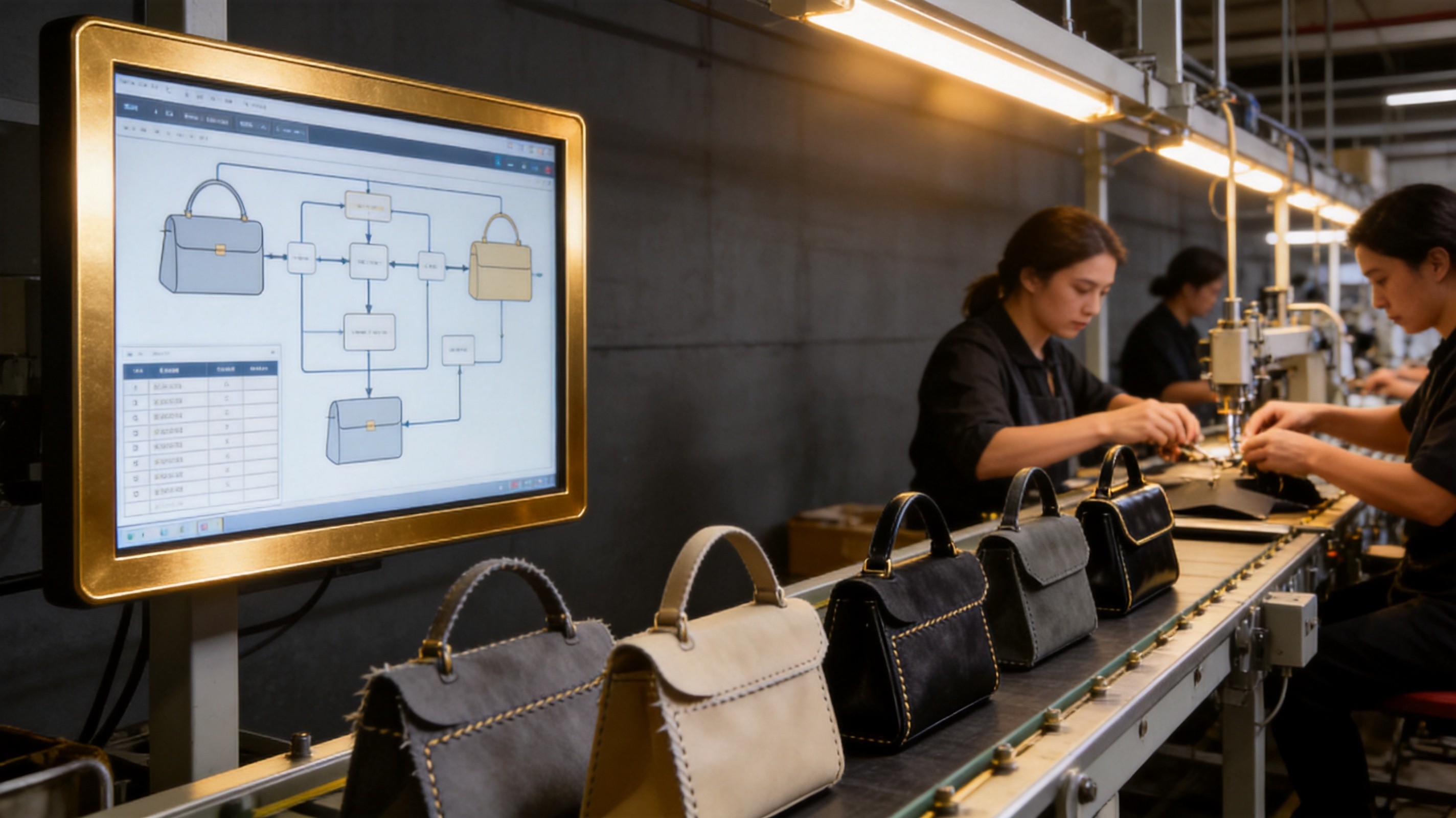
Effective negotiation combines preparation, leverage, and relationship building for sustainable results
Understanding Handbag Cost Structure
You cannot negotiate effectively without understanding what drives costs. The factory's price is not arbitrary; it is composed of identifiable cost components, each with its own margin for negotiation. Breaking down the cost structure gives you specific areas to discuss and optimize.
| Cost Component | Percentage of Total | Negotiation Potential | Optimization Levers |
|---|---|---|---|
| Materials (Leather/Fabric) | 35-45% | Medium | Material grade, alternative sourcing |
| Labor | 20-30% | Low-Medium | Simplified construction, efficiency |
| Hardware/Accessories | 10-15% | Medium | Standard vs custom, volume pricing |
| Overhead/Factory Margin | 10-15% | High | Volume commitment, relationship |
| Packaging | 3-5% | Medium | Simplified packaging, buyer-supplied |
| Shipping/Logistics | 5-10% | High | Shipping method, consolidation |

Material selection directly impacts cost structure and negotiation leverage points
Materials represent the largest cost component and are somewhat flexible through material grade selection and sourcing alternatives. Labor costs are relatively fixed in established manufacturing regions but can be influenced by design simplification. Hardware costs can be reduced by using standard rather than custom components. Factory overhead and margin are where the most negotiation leverage exists, particularly when you can offer volume commitments or long-term partnership value.
Factors That Influence Wholesale Handbag Pricing
Multiple factors determine the wholesale price a factory quotes for handbags. Understanding each factor helps you identify which elements you can modify to achieve lower pricing without sacrificing quality.
- Order quantity: Higher volumes reduce per-unit fixed costs; the most significant pricing lever
- Material selection: Full-grain leather costs 2-3x more than PU leather; material choice is the largest cost driver
- Design complexity: More pieces, pockets, and construction steps increase labor time and cost
- Hardware customization: Custom hardware adds 20-40% to hardware costs versus standard components
- Color and finish: Specialty dyes, prints, and finishes add material cost and processing time
- Season and factory capacity: Orders placed during factory low seasons (typically February-March) may receive better pricing
- Relationship and payment history: Established customers with reliable payment records receive preferential pricing
How to Calculate Target Landed Cost
Before entering any negotiation, calculate your target landed cost: the total cost of getting one unit from the factory to your warehouse, ready for sale. This figure determines the maximum price you can pay while achieving your target margin.
Landed Cost Formula
Landed Cost = Factory Unit Price + Shipping Cost per Unit + Import Duties + Insurance + Customs Brokerage + Domestic Freight to Warehouse. Example: Factory price $25 + Ocean freight $1.20 + Duty at 12% ($3.00) + Insurance $0.15 + Brokerage $0.10 + Domestic freight $0.50 = Total Landed Cost $29.95 per unit.
Once you know your target landed cost, work backward to determine the maximum factory price you can accept. If your target retail price is $89 with a 65 percent target margin, your maximum landed cost is $31.15. Subtract shipping, duties, and other costs to determine the maximum factory price: $31.15 minus $5.45 in non-factory costs equals $25.70 maximum factory price. This calculation gives you a clear walk-away price before negotiation begins.
Preparation Before Negotiation: Research and Data
The single most important determinant of negotiation success is preparation. Buyers who enter negotiation with data, alternatives, and clear objectives consistently outperform those who negotiate reactively.
Preparation should include: obtaining quotes from at least three qualified factories for the same specifications, researching material costs to understand what is reasonable, calculating your target landed cost and maximum acceptable factory price, determining your walk-away price and ideal outcomes, understanding the factory's likely cost structure, and preparing a list of negotiable items beyond unit price. Entering negotiation without this preparation means you are reacting to the factory's position rather than driving toward your objectives.
Building Leverage: Volume, Frequency, and Relationships
Negotiation leverage comes from the value you bring to the factory relationship. Factories offer better pricing to buyers who provide predictable volume, reliable payment, growth potential, and strategic partnership value. Building leverage is a continuous process, not a one-time event.
Volume leverage is the most direct: larger orders reduce the factory's per-unit setup costs and improve their production efficiency. Frequency leverage comes from consistent ordering patterns that help the factory plan production capacity. Relationship leverage develops over time through trust, communication quality, and mutual respect. The most powerful buyers combine all three: they provide significant volume through regular orders while building genuine partnership relationships that make the factory invested in their success.
Understanding cost components gives you specific negotiation targets for each element
Negotiation Tactics That Actually Work with Chinese Factories
Specific negotiation tactics work particularly well in the Chinese factory context. These tactics respect cultural norms while driving toward your commercial objectives.
- The Anchor: Present your target price first based on your research. This anchors the negotiation around your number rather than their opening quote
- The Broken Record: Calmly and consistently repeat your target price with different justifications each time
- The Volume Commitment: Offer to increase order size in exchange for lower per-unit pricing
- The Multi-Style Package: Bundle multiple styles into a single order to increase total factory utilization
- The Long-Term Partnership: Frame pricing discussions within the context of a growing, multi-year relationship
- The Silent Treatment: After receiving a price, pause without responding. The silence creates pressure to improve the offer
- The Alternative: Mention competing quotes without revealing specific numbers to create competitive tension
Avoid aggressive or confrontational tactics. Chinese business culture values harmony and face. Pushing too hard on price at the expense of the relationship damages long-term value. The best outcomes come from collaborative negotiation where both parties feel they have achieved a fair result.
When to Push for Price vs When to Accept
Not every price deserves aggressive negotiation. Knowing when to push and when to accept is a strategic decision that balances immediate cost savings against long-term relationship value and quality implications.
Push for lower prices when the quote is clearly above market rates, you have competitive quotes significantly below the current offer, you can offer meaningful volume increases, you are ordering commodity-style products with many competing factories, or the relationship is transactional with no strategic value. Accept the price when the factory offers superior quality or service justifying the premium, pushing too hard risks relationship damage with a strategically important partner, the price is already at or below market, the factory provides unique capabilities not easily replicated, or the total value including quality, delivery, and service justifies the cost.
Negotiating Beyond Price: Payment Terms, Shipping, and Extras
The most skilled negotiators look beyond unit price to the full commercial package. Payment terms, shipping arrangements, sample costs, and value-added services all contribute to your total cost and can often be negotiated more easily than unit price.
| Negotiable Element | Standard Terms | Target Terms | Value to Buyer |
|---|---|---|---|
| Payment Terms | 30% deposit, 70% before ship | 30% deposit, 70% net 30 | $5K-$20K cash flow improvement |
| Sample Costs | $50-$200 per style | Free with order commitment | $200-$1,000 saved per collection |
| Shipping Terms | EXW (buyer arranges all) | FOB (factory handles to port) | $500-$2,000 logistics savings |
| QC Inspection | Buyer pays all inspection | Factory provides pre-ship photos | $200-$350 per inspection saved |
| Packaging | Standard poly bag | Custom branded packaging included | $0.50-$2.00 per unit value |
| Lead Time | 60-90 days standard | 45-60 days or priority slot | Faster market response |
Each of these elements represents real financial value. Improving payment terms from "70% before shipment" to "70% net 30 days" effectively saves you 30 days of working capital on every order. Getting the factory to cover FOB charges saves you the cost and complexity of domestic Chinese logistics. These non-price improvements often deliver more total value than a few percentage points off unit price. For additional strategies on managing bulk order costs, see our guide on ensuring quality across bulk orders.
Handling Price Increases and Raw Material Fluctuations
Raw material costs fluctuate, and factories periodically request price increases. How you handle these requests affects both your costs and your supplier relationships. The goal is to manage increases collaboratively rather than confrontationally.
When a factory requests a price increase, follow a structured response process: request detailed documentation showing the specific cost drivers (not just "materials went up"), verify claims against publicly available commodity price data, negotiate the timing and magnitude (accept gradual increases rather than sudden large jumps), explore alternatives to reduce cost impact (material substitutions, design simplifications), and consider a shared-burden approach where both parties absorb a portion. For long-term stability, negotiate annual contracts with quarterly price review clauses that provide a framework for managing fluctuations predictably.

Documenting negotiated agreements prevents misunderstandings and protects both parties
Multi-Factory Bidding Strategies
Maintaining relationships with multiple qualified factories provides negotiating leverage and supply chain security. The multi-factory bidding strategy creates competitive tension that drives better pricing while ensuring you are never dependent on a single supplier.
Develop relationships with three to five qualified factories at similar capability levels. For each new order or style, request quotes from all qualified factories using identical specifications. Share transparently that you are comparing multiple quotes without revealing specific competitor pricing. Evaluate total value including price, quality track record, communication responsiveness, and delivery reliability. Award orders based on best overall value, not lowest price alone. Rotate orders among qualified factories to maintain relationships and keep competitive tension active. This approach consistently delivers 10 to 20 percent better pricing than single-factory sourcing.
Long-Term Contracts vs Spot Purchasing
The choice between long-term contracts and spot purchasing affects both your pricing and your supply chain flexibility. Each approach has merits depending on your business model and market conditions.
Long-term contracts (6 to 12 months) provide pricing stability, guaranteed production capacity, and typically 5 to 10 percent better unit pricing due to the factory's visibility into future volume. However, they reduce flexibility to respond to market changes and may lock you into pricing that becomes uncompetitive if material costs decline. Spot purchasing offers maximum flexibility and the ability to capture market-price declines but provides no capacity guarantee and typically higher per-unit pricing. The optimal approach for most buyers combines a base volume under long-term contract (60-70% of projected annual volume) with spot purchasing for additional needs and trend-responsive orders.

Understanding quality-price trade-offs prevents hidden costs that exceed apparent savings
Quality-Price Trade-Offs: When Cheaper Costs More
The cheapest price is not always the best value. Understanding when a lower price creates hidden costs that exceed the apparent savings is essential for smart procurement decisions. Quality-price trade-offs should be evaluated on total cost of ownership, not just unit price.
Hidden costs of lower-quality, lower-priced products include higher return rates (each return costs $5 to $15 in processing, shipping, and lost margin), customer complaints and reputation damage (difficult to quantify but real), increased inspection costs (more frequent or detailed QC needed), replacement and warranty costs, and inventory write-offs for defective products. A factory charging $28 per unit with 1 percent defect rates may deliver better total value than a factory charging $25 per unit with 5 percent defect rates. Always factor quality expectations into price negotiations and use total landed cost plus quality cost as your comparison metric.
Currency Exchange Considerations for International Orders
For international handbag procurement, currency exchange rates directly affect your effective pricing. A weakening of your domestic currency against the Chinese yuan increases your effective cost even if the factory price remains unchanged. Understanding and managing currency risk is part of professional procurement.
Most Chinese factories quote in US dollars, which simplifies pricing but transfers currency risk to the factory. Some factories may offer lower prices for yuan-denominated orders if they prefer to avoid their own currency conversion costs. Monitor exchange rate trends and consider timing large orders when your domestic currency is strong relative to the yuan. For very large annual procurement volumes, consider currency hedging strategies through your bank to lock in exchange rates and eliminate uncertainty.
Documenting Agreements and Avoiding Misunderstandings
| Document Element | Purpose | Risk if Omitted |
|---|---|---|
| Unit Price with Currency | Clear pricing commitment | Price disputes, currency confusion |
| Payment Schedule | Cash flow clarity for both parties | Late payment penalties, relationship strain |
| Delivery Terms (Incoterms) | Risk and cost allocation | Shipping cost disputes, insurance gaps |
| Quality Standards Reference | Objective quality benchmark | Quality disputes, rejection costs |
| Defect Resolution Process | Clear remedy procedure | Unresolved defects, financial loss |
| IP and Exclusivity Terms | Design protection | Design copying, market competition |
Every negotiated agreement should be documented in writing with clear, unambiguous terms. Verbal agreements lead to misunderstandings, especially across language and cultural barriers. Written documentation protects both parties and provides a reference for resolving any disputes.
A purchase order documenting negotiated terms should include: unit price and total order value, payment terms with specific dates and percentages, delivery timeline with specific dates, quality standards referencing approved samples, packaging specifications, shipping terms (FOB, CIF, etc.), warranty or defect resolution procedures, and any special conditions or commitments from either party. Both parties should sign or formally acknowledge the purchase order before production begins. For initial relationships, our manufacturing services team provides transparent documentation throughout the order process.

Strong factory relationships built on trust and mutual benefit generate long-term pricing advantages
Building Win-Win Supplier Relationships
The best negotiation outcomes are those where both parties feel satisfied with the result. Win-win relationships generate better pricing over time, priority treatment during capacity constraints, collaborative problem-solving when issues arise, and genuine investment in your business success. These intangible benefits often exceed the value of any single negotiation.
Build win-win relationships by ensuring the factory makes reasonable profit on your orders (squeezing them to zero margin creates resentment and quality shortcuts), paying on time consistently, communicating clearly and respectfully, providing advance visibility into your future needs, visiting the factory regularly, showing appreciation for good work, and treating factory staff as partners rather than vendors. Factories that feel valued and respected will go the extra mile for you: absorbing small cost increases, prioritizing your orders during busy seasons, investing in quality improvements for your products, and providing honest advice when they see problems developing.
Building a strong partnership with a manufacturer like Junyuan Bags, founded in 2004 with over 20 years of experience, provides the stability and collaboration that drives long-term pricing advantages. Reach out via WhatsApp at +86 17750020688 or email service@junyuanbags.com to discuss pricing and partnership opportunities.
Transparent Pricing from an Experienced Factory
Junyuan Bags provides competitive, transparent pricing backed by 20+ years of manufacturing expertise. Our 30,000 sqm factory and 300+ workers deliver consistent quality at fair prices for wholesale buyers worldwide.
WhatsApp: +86 17750020688 | Email: service@junyuanbags.com
MOQ: 200 pcs/style | Factory: Quanzhou, Fujian, China
Frequently Asked Questions
What discount can wholesale buyers expect for bulk orders?
Expect 10-15% discount for 200-500 pieces per style, 20-30% for 500-1,000 pieces, and 30-40% for orders exceeding 1,000 pieces. Multi-style orders and reorder commitments can add another 5-8% reduction. Total combined discounts from base pricing can reach 35-45% for high-volume, committed buyers.
How do you negotiate payment terms with factories?
Start with standard 30/70 terms, then improve gradually as trust builds. Offer larger volume in exchange for extended payment windows (net 30 instead of before shipment). After 3-5 successful transactions, experienced buyers can achieve net 30 or net 60 terms on repeat orders. Provide bank references to reduce factory risk perception.
How should buyers handle factory price increases?
Request detailed documentation of cost drivers, verify against market data, negotiate timing and magnitude (gradual vs sudden), explore material alternatives, and consider shared-burden approaches. Long-term contracts with quarterly price review clauses provide predictable frameworks for managing fluctuations.
What is the multi-factory bidding strategy?
Obtain quotes from 3-5 qualified factories using identical specifications, share that you are comparing quotes without revealing specific numbers, evaluate total value not just price, and award based on best overall value. Maintain 2-3 active factory relationships for competitive leverage and supply chain backup.
When should buyers accept higher prices?
Accept higher prices when the factory demonstrates superior quality consistency, faster turnaround, design support expertise, dedicated production capacity, or strategic partnership value. The cheapest price often creates hidden costs through higher defect rates and reliability issues that exceed the apparent savings.
Limitations and Scope of This Guide
This guide covers price negotiation strategies for wholesale handbag buyers, including volume leverage, seasonal timing, and multi-season commitments. It is based on our experience as a handbag manufacturer in Quanzhou, China, serving brands worldwide since 2004. Key limitations to keep in mind:
- Negotiation dynamics depend on market conditions, factory capacity utilization, and the specific buyer-supplier relationship. No single strategy works universally.
- Target price reductions are based on typical wholesale handbag negotiations. Aggressive price demands may result in quality compromises—balance cost with specifications.
- This guide focuses on buyer-side strategies. Factories also negotiate to protect margins, and understanding their cost structure helps set realistic expectations.
For advice tailored to your specific situation, contact our team directly.