Table of Contents
- Why Quality Control Is Non-Negotiable
- QC Stages: Pre-Production, In-Process, Final Inspection
- Pre-Production: Material Verification
- In-Process: Stitching, Assembly, Hardware Checks
- Final Inspection: AQL Standards
- Visual Quality Standards
- Functional Testing: Zippers, Straps, Closures
- Dimensional Accuracy Checks
- Color Consistency and Dye Lot Matching
- Packaging and Labeling QC
- Documenting and Communicating QC Results
- Third-Party Inspection vs Factory QC
- Defect Classification and Severity
- Corrective Action Procedures
- Frequently Asked Questions
Quality control in handbag manufacturing is not a luxury — it is the foundation of your brand's reputation. A single defective bag reaching a customer can trigger negative reviews, returns, and lost trust that takes months to rebuild. At scale, quality failures multiply in cost and impact, turning manageable defects into brand crises.
This comprehensive QC checklist covers every inspection stage from material verification through final shipment, providing actionable standards that protect your brand. Based on quality systems implemented across our 30,000 sqm facility with 300+ workers, these protocols represent the standards that keep defect rates below 1% across 20+ years of production.
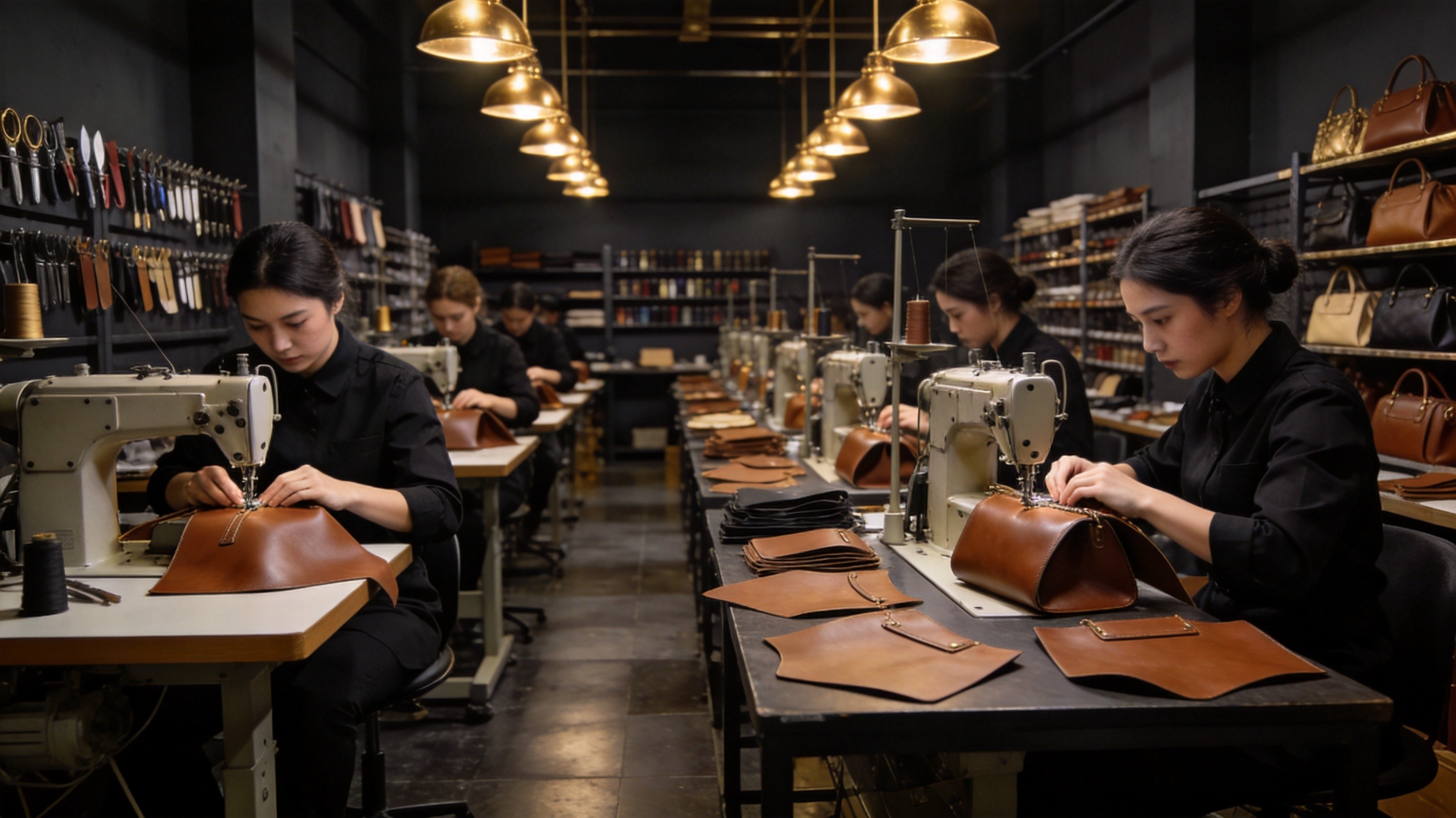
Systematic quality control at every production stage ensures consistent output quality
Why Quality Control Is Non-Negotiable
Handbags occupy a unique position in consumer products — they are both functional items and fashion statements. Customers evaluate them through both practical and aesthetic lenses, creating a broader quality standard than most product categories.
The Cost of Quality Failures
A defective handbag that reaches a customer creates cascading costs: the return shipping ($8-15), the replacement unit ($25-65), the customer service time, the negative review impact on conversion rates, and the potential social media amplification. For a brand selling at $120 retail, a single quality failure can cost $200+ in total impact — far exceeding the $0.50-2.00 per unit investment in proper QC.
Scale Amplifies QC Importance
At 200 units, a 3% defect rate means 6 defective bags. At 10,000 units, the same rate means 300 defective bags — representing $7,500-19,500 in direct replacement costs plus the reputational damage. Quality control systems must be proportional to production volume.
QC Stages: Pre-Production, In-Process, Final Inspection
Effective quality control operates across three distinct stages, each catching different categories of defects at the point where correction is most cost-effective.
The Three-Stage QC Framework
Pre-production QC prevents defects by verifying materials and setup before cutting begins. In-process QC catches defects during construction when they are still correctable. Final inspection identifies defects in finished goods before they ship. Each stage addresses different quality dimensions, and all three are essential for comprehensive quality assurance.
Pre-Production: Material Verification
Pre-production inspection prevents the most costly quality failures — those caused by incorrect or substandard materials that only become apparent after production is complete.
Material Verification Checklist
- Leather/material grade — confirm against approved swatch; check for grain consistency, thickness, and hand feel
- Material color — compare against approved color standard under standardized lighting (D65 daylight)
- Lining material — verify fabric type, weight, color, and print alignment
- Hardware — check finish color, weight, function, and branding accuracy against specifications
- Thread — verify color match, weight/denier, and material composition
- Interfacing and reinforcement — confirm type, weight, and placement areas
- Adhesives — verify type and application suitability for bonded materials
Pre-Production Sample Verification
Before bulk production begins, verify the pre-production sample (PP sample) against all approved specifications. The PP sample confirms that the factory correctly interpreted your tech pack, sourced the right materials, and set up production equipment correctly. Never authorize bulk production without PP sample approval.
In-Process: Stitching, Assembly, Hardware Checks
In-process inspection catches defects during construction when they can be corrected without scrapping completed units. This is the most cost-effective stage for quality intervention.
Stitching Quality Checks
| Check Point | Standard | Common Defect | Severity |
|---|---|---|---|
| Stitch density | 8-10 stitches per inch (leather), 10-12 (textile) | Below spec: weak seams | Major |
| Stitch straightness | Straight within 1mm tolerance along seam | Wavy or curved stitching | Minor-Major |
| Back-tacking | 3-4 reverse stitches at start and end | Missing back-tack: seam unraveling | Major |
| Thread tension | Balanced — no loops on either side | Loose tension: visible loops | Minor |
| Thread color | Matches approved specification | Wrong color thread | Major |
| Seam allowance | Consistent per specification (typically 5-8mm) | Inconsistent: uneven edges | Minor |
Hardware Attachment Checks
Verify that all hardware is securely attached with no visible glue marks, that hardware finish is free of scratches and discoloration, that zippers operate smoothly through full range of motion, that magnetic closures align correctly and provide adequate holding force, and that logo plates are straight, centered, and securely affixed.

Hardware inspection ensures zippers, clasps, and fittings meet functional and aesthetic standards
Final Inspection: AQL Standards
Final inspection uses statistical sampling to determine whether a production lot meets acceptable quality standards before shipment. AQL (Acceptable Quality Limit) provides an objective, internationally recognized framework for this decision.
Understanding AQL for Handbags
AQL defines the maximum number of defects acceptable in a sampled lot. For handbags, the industry standard uses:
- Critical defects: AQL 0 — zero tolerance for safety hazards or regulatory violations
- Major defects: AQL 2.5 — functional failures, significant cosmetic issues, incorrect specifications
- Minor defects: AQL 4.0 — slight cosmetic imperfections not affecting function
Sample Size Determination
| Lot Size | Sample Size | Accept (Major, AQL 2.5) | Reject (Major) | Accept (Minor, AQL 4.0) | Reject (Minor) |
|---|---|---|---|---|---|
| 91-150 | 20 | 1 | 2 | 2 | 3 |
| 151-280 | 32 | 2 | 3 | 3 | 4 |
| 281-500 | 50 | 3 | 4 | 5 | 6 |
| 501-1,200 | 80 | 5 | 6 | 7 | 8 |
| 1,201-3,200 | 125 | 7 | 8 | 10 | 11 |
| 3,201-10,000 | 200 | 14 | 15 | 14 | 15 |
Visual Quality Standards
Visual inspection evaluates the aesthetic quality that customers see and feel when they first encounter your product. These standards should be defined with photographic reference examples — both acceptable and unacceptable.
Key Visual Quality Criteria
- Surface appearance — no visible scratches, stains, glue marks, or discoloration on exterior surfaces
- Edge finishing — clean, even edges with no fraying, peeling, or exposed raw material
- Symmetry — left and right sides mirror each other; pockets, flaps, and design elements are balanced
- Pattern alignment — for printed or textured materials, patterns match at seams and continue consistently
- Overall structure — bag holds its intended shape; no collapsing, warping, or asymmetrical bulging

Visual inspection under standardized lighting reveals surface defects and color inconsistencies
Functional Testing: Zippers, Straps, Closures
Functional testing ensures every moving part works correctly and every structural element withstands normal use. These tests should be performed on sampled units from every production lot.
Functional Test Protocol
- Zipper test — open and close 20 cycles; must operate smoothly without catching or separating
- Strap pull test — apply 15 kg (33 lbs) force for 30 seconds; strap attachment must not stretch, separate, or deform
- Closure test — magnetic snaps, turn locks, and buckles must engage and release properly for 50 cycles
- Weight load test — fill bag to rated capacity (typically 3-5 kg); bag must maintain structural integrity with no seam stress
- Drop test — drop from 76 cm (table height) onto hard surface in 6 orientations; no structural damage or hardware detachment
Dimensional Accuracy Checks
Dimensional accuracy ensures every unit conforms to your specified measurements within acceptable tolerance ranges.
Key Dimensional Measurements
Measure length (top edge), height (center front), depth/gusset width, strap drop length, handle circumference, and pocket placement. Tolerance is typically ±3mm for dimensions under 200mm and ±5mm for dimensions over 200mm. Measurements should be taken with the bag in its natural resting position, not stretched or compressed.
Color Consistency and Dye Lot Matching
Color variation between units in the same order is one of the most visible and customer-noticeable quality failures.
Color QC Protocol
Compare all units against the approved color standard under D65 standardized lighting. Check for variation within the same production lot (shade variation between units) and within individual units (shade variation across different panels of the same bag). Any visible color difference when bags are placed side by side indicates a dye lot problem that must be addressed before shipment.
Packaging and Labeling QC
Packaging and labeling errors can cause customs delays, retail rejection, and customer confusion. These checks are often overlooked but carry significant commercial consequences.
Packaging QC Checklist
- Country of origin label — present, accurate, permanently attached, and legible
- Brand label — correctly positioned, securely attached, and free of defects
- Care/content labels — accurate material composition, correct care instructions
- Barcode/UPC — scannable, correctly assigned to the specific style/color/size
- Dust bag — correct material, logo printing quality, appropriate size
- Carton markings — style, color, quantity per carton, carton number, gross/net weight, dimensions
- Packing method — bags properly stuffed with tissue, wrapped in protective material, positioned to prevent crushing
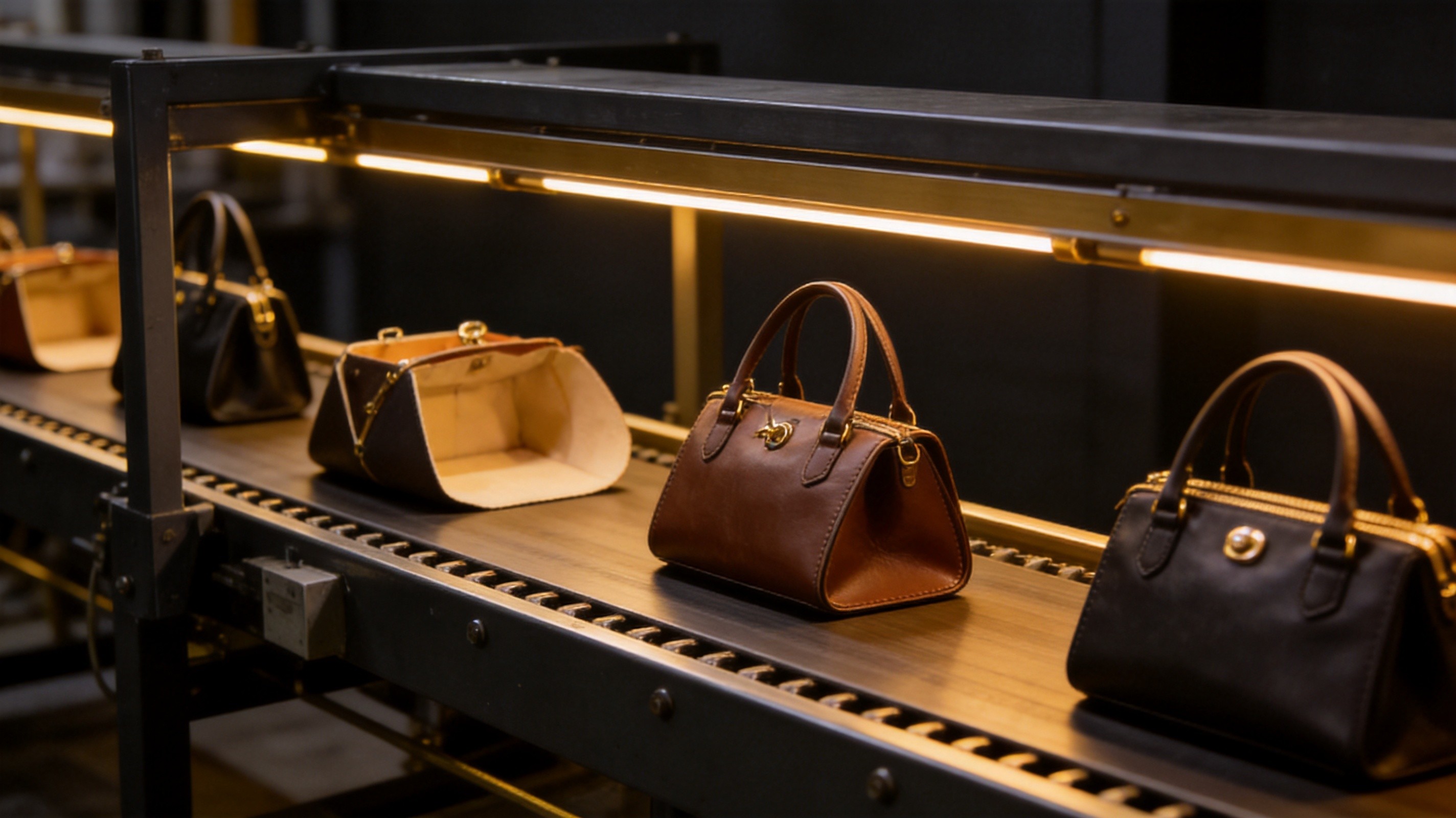
Proper packaging and labeling QC prevents customs delays and retail compliance issues
Documenting and Communicating QC Results
QC results must be documented systematically and communicated clearly to enable swift corrective action when issues are found.
QC Report Structure
Every QC inspection should produce a written report including: order number and style details, inspection date and inspector identity, sample size and selection method, defect summary organized by type and severity, photographic evidence of any defects found, pass/fail determination with AQL calculation, and corrective action recommendations for any failures.
Documentation Best Practice
Photograph every defect found during inspection — close-up shots showing the specific issue, plus wider shots providing context. Date-stamp all photos. These images serve as evidence for corrective action discussions with your factory and create a reference library for training production teams on quality standards.
Third-Party Inspection vs Factory QC
Both factory-conducted QC and independent third-party inspection serve important roles in comprehensive quality assurance.
Factory QC Advantages
Factory QC teams understand your product specifications intimately, can intervene during production to correct issues in real time, and provide continuous quality monitoring throughout the production run. However, factory QC cannot provide fully independent assessment — there is inherent conflict of interest when the producer also judges their own output quality.
Third-Party Inspection Advantages
Third-party inspectors from SGS, Intertek, or Bureau Veritas provide unbiased assessment. Their findings carry credibility in disputes and provide confidence that the inspection was thorough and objective. For orders above 2,000 units or when working with a new factory, third-party inspection is strongly recommended.
For a comprehensive approach to factory evaluation that includes quality system assessment, see our factory audit checklist and guide to red flags when choosing a handbag OEM factory.
Defect Classification and Severity
Classifying defects by severity ensures consistent decision-making about whether to accept, rework, or reject production lots.
| Severity | Definition | Examples | Action |
|---|---|---|---|
| Critical | Unsafe or violates regulations | Sharp edges, toxic materials, missing required labels | Reject lot immediately |
| Major | Affects function or significantly impacts appearance | Broken zipper, detached strap, wrong color, large stain | Rework or reject affected units |
| Minor | Slight cosmetic issue, does not affect function | Minor thread tail, slight color shading, small glue mark | Accept within AQL limits |
Corrective Action Procedures
When inspection reveals quality failures, a structured corrective action process ensures issues are resolved systematically and do not recur.
The Corrective Action Framework
- Document — record all defects with photos and descriptions
- Classify — categorize by type, frequency, and severity
- Communicate — share inspection report with factory within 24 hours
- Root cause — work with factory to identify why defects occurred
- Correct — rework affected units or reject and replace
- Prevent — implement process changes to prevent recurrence
- Verify — re-inspect after corrective action to confirm resolution
For brands seeking a manufacturing partner with systematic quality control built into every production stage, Purse Private Label implements multi-stage QC protocols across our 30,000 sqm Quanzhou facility. Our quality systems, developed over 20+ years of international production, maintain defect rates below 1% across all product categories.
Our product range demonstrates the quality that systematic QC delivers — consistent construction, precise detailing, and reliable durability across every piece.
Need a Manufacturing Partner with Rigorous Quality Control?
Our multi-stage QC system keeps defect rates below 1%. MOQ from 200 pcs.
📧 service@junyuanbags.com | 📱 +86 17750020688 | MOQ: 200 pcs/style
Frequently Asked Questions
What AQL standard should I use for handbag quality inspection?
For handbags, an AQL of 2.5 for major defects and 4.0 for minor defects is industry standard. Major defects include functional failures and significant cosmetic issues. Minor defects are slight imperfections that do not affect function.
How many bags should I inspect from a 5,000-unit production run?
Using ANSI/ASQ Z1.4 at General Inspection Level II, a lot size of 5,000 units requires a sample size of 200 units. The acceptance number for AQL 2.5 (major defects) is 14, meaning if 15 or more major defects are found, the lot fails.
What are the most common quality defects in handbag manufacturing?
The most common defects include uneven stitching, edge finishing inconsistencies, hardware scratching or incorrect color, color variation between pieces, dimensional inaccuracy, visible glue marks, interior lining wrinkles, and zipper function issues.
Should I hire a third-party inspector or use factory QC?
Use both. Factory QC provides continuous in-process monitoring. Third-party inspection provides independent verification. For orders above 2,000 units or new factory relationships, third-party inspection is strongly recommended.
Limitations and Scope of This Guide
This guide covers complete quality control checklist for private label handbags, covering incoming materials, in-process inspection, and final examination. It is based on our experience as a handbag manufacturer in Quanzhou, China, serving brands worldwide since 2004. Key limitations to keep in mind:
- This checklist is comprehensive and may exceed what is practical for every order. Prioritize inspection points based on your product complexity and risk tolerance.
- Quality standards in this checklist reflect mid-to-premium market expectations. Value-market products may accept wider tolerances on certain parameters.
- Third-party inspection services charge per man-day. Full implementation of this checklist for every order may be cost-prohibitive for smaller brands.
For advice tailored to your specific situation, contact our team directly.